
After Renée Good’s murder on January 6, Maine went on high alert. Customs and Border Patrol and ICE were already bragging that they had detained 1,000 people in Maine in 2025. We expected to be targeted next as Trump raged against our Somali community concentrated in Lewiston and Portland. Information began to filter in through immigrant families and organizers and eventually through some of our friends in high places. By January 12, we were relatively certain we were next and groups all over the state moved into action.
We did not start from a standstill. In previous months, the Maine Immigrants Rights Coalition had established an ICE hotline, Presenté Maine had trained hundreds of verifiers (volunteers who document and report ICE activity), the People’s Coalition for Safety and Justice had set up the Maine Solidarity Fund — to date raising more than $250,000 — teachers in Portland had pushed school administrators to train staff in their Fourth Amendment rights, led by Prevention Action Change, the Community Organizing Alliance in Lewiston had strengthened its mutual aid and organizing infrastructure in the wake of a protest in defense of the Somali community in December, the Maine Council of Churches had spread the word in their congregations, Multifaith Justice Maine had organized clergy to take direct action, Maine AFL-CIO had organized transportation for vulnerable workers, Indivisible chapters had led protests and helped monitor ICE activity, the Maine Coalition for Peace and Human Rights — a central force in the Gaza solidarity movement — had turned out its network and connected the fight to divest state pension funds from apartheid to divesting from companies that profit from ICE, and Maine Democratic Socialists of America had worked alongside the Party for Socialism and Liberation to host anti-ICE rallies in Portland.
No ICE for Maine
In short, people all over the state from all walks of life responded. An organization called No ICE for Maine played a useful role communicating between organizations and opening paths for common work.
A collective of organizers consisting of individuals from unions, DSA, direct action activists, Presenté Maine, and some new folks came together last spring in No ICE for Maine. Structured very loosely without affiliations from larger groups, No ICE demanded that the Cumberland County Commissioners in Portland sever their contract with ICE, which had turned the county jail into the largest immigrant detention facility in Maine. After thousands turned out for May Day protests across the state, this campaign became one focus of targeted organizing between May and December of last year, bringing hundreds of people together to protest and speak at public comment, demanding an end to county collaboration with ICE. No ICE for Maine gathered thousands of signatures, built an email and Instagram following, crafted legal and legislative arguments, lobbied commissioners, and drew enough media attention to command a critical measure of organizing capacity by the new year.
Starting on the day of Good’s murder, No ICE for Maine held a series of emergency discussions about tactics. After several sharp but productive debates, No ICE for Maine decided on January 9 to put out a call to people across the state to join an organizing Zoom on January 15. We had initially conceived of the call as more of an organizing and strategy session, but within hours of publicizing the invitation on January 12, some 250 people had signed up. The next day we had 500 RSVPs, and by the morning of the call, some 1,600 people from 157 towns were registered. That call did not create Maine’s massive response, but it did help give shape to it.
The strategic goal set out on the call was simple: defeat “Operation Catch of the Day,” as ICE named its invasion. Mainers pursued three principal tactics to confront the invasion:
- We go where they go. The Maine ICE hotline lit up and hundreds of verifiers put their training to good use. Thousands more joined rapid response networks run on Signal. Workers in education, health, manufacturing, construction, retail, and entertainment learned their Fourth Amendment rights. Hundreds of parents and community members organized school watches. We found ICE’s hotels and the Maine Road Salt band formed to serenade them at night.
- Mass, nonviolent, direct action. Large rallies and marches were planned, clergy organized sit-ins at Senator Collins’s office, and plans were conceived for mass civil disobedience, training to put our bodies on the line in an organized and disciplined way.
- Mutual aid. Thousands of immigrant workers made the courageous decision to shelter in place to defend their families. Kids didn’t go to school. Breadwinners lost wages. The Maine Solidarity Fund, Food for All, Project Relief, and many others helped provide the material support necessary to make this stay-at-home action possible.
United Front
This is the kind of united front approach we must learn to apply in the fight against ICE. None of us is strong enough on our own. The united front is not a preference, it is a necessity. We learn how to draw different forces closer together, how to work with — and against — politicians, how to develop demands while concluding honest compromises, how to create and earn trust. These are the intangibles that can only come with practice, within the united front strategic framework.
ICE announced that its reign of terror would begin on Martin Luther King Day, January 19. However, Mother Nature stepped in to give us another day to prepare by blanketing the state with 18 inches of snow. That time was critical as it gave us an extra day to put rapid response networks in place.
On January 20, all hell broke loose. Hundreds of ICE agents swarmed between Portland and Biddeford, 17 miles away. They invaded neighborhoods, dragged workers off roofing jobs, forced schools into lockdown, and blatantly racially profiled drivers, pulling over Black and Brown people at will. They detained custodians, construction and restaurant workers, school employees, and pastors. They even abducted a Cumberland County Jail guard and the father of a premature newborn when he went to check on his other kids at home.
Agents raced through the streets, breaking speed limits and driving recklessly. They threatened and mocked verifiers and rapid responders. They followed activists home and called them terrorists. They did not commit as much violence as in Minneapolis, but the stage was set and they were clearly itching to do so.
Between January 20 and 24, ICE claimed to have kidnapped 206 people. The obviously random and racist dragnet led all of Maine’s highest elected leaders to denounce their actions. The governor called them provocateurs, the attorney general opened an ICE abuse tip line, the Cumberland County Sheriff called them “bush league,” and the mayors of Lewiston and Portland directed their police not to cooperate — although Portland police did arrest peaceful protesters.
In the middle of that week, No ICE for Maine organizers made two decisions. First, we would organize a mass meeting of thousands, set for February 7, to unveil plans for major escalations if ICE did not retreat by then. We had no expectation that they would, so this was a mechanism to focus the resistance on mass, nonviolent tactics to reduce the risk that ICE would kill one of us and to find a level to impede their operation.
Second, we helped convene an organizing call with labor, clergy, immigrant-led organizations, and progressive community groups on January 26. This call brought together around 30 people in key places. We expected ICE would expand its operations from the Portland area, so this communication with statewide organizations sought to share what we were learning in the Portland area and to talk through the February 7 plan.
No Mood to Back Down
At the end of week one, ICE had succeeded in inflicting real damage and sowing terror among our immigrant neighbors — thousands of workers stayed home and attendance dropped dramatically in many schools — but it had not broken their resolve. And the broader movement, although fearful that ICE would escalate its violence, was standing squarely on its two feet and was in no mood to back down.
In fact, Alex Pretti’s murder on January 24 set the stage for an expansion of the movement, as restaurant and entertainment workers and small businesses announced plans for a January 30 strike in solidarity with Minneapolis and high school students planned to walk out or boycott classes. If the tactics of “We go where they go” and “Mutual aid” were most important during weeks one and two, “Mass, nonviolent direct action” a la Martin Luther King were coming into focus for week three.
ICE Stands Down
But then something remarkable took place. Starting on January 26, rapid responders and verifiers noticed a significant reduction in ICE activity. I believe some combination of the’ heroism in Minneapolis, our own determination to defend Maine, and the potential collapse of Senator Collins’s reelection chances — with the rise of left-wing firebrand Graham Platner’s campaign — led the Trump administration to blink.
Before dawn on January 29, Collins announced that ICE’s “enhanced enforcement” operation was ending. While no one believes her as far as they can throw her, ICE did retreat.
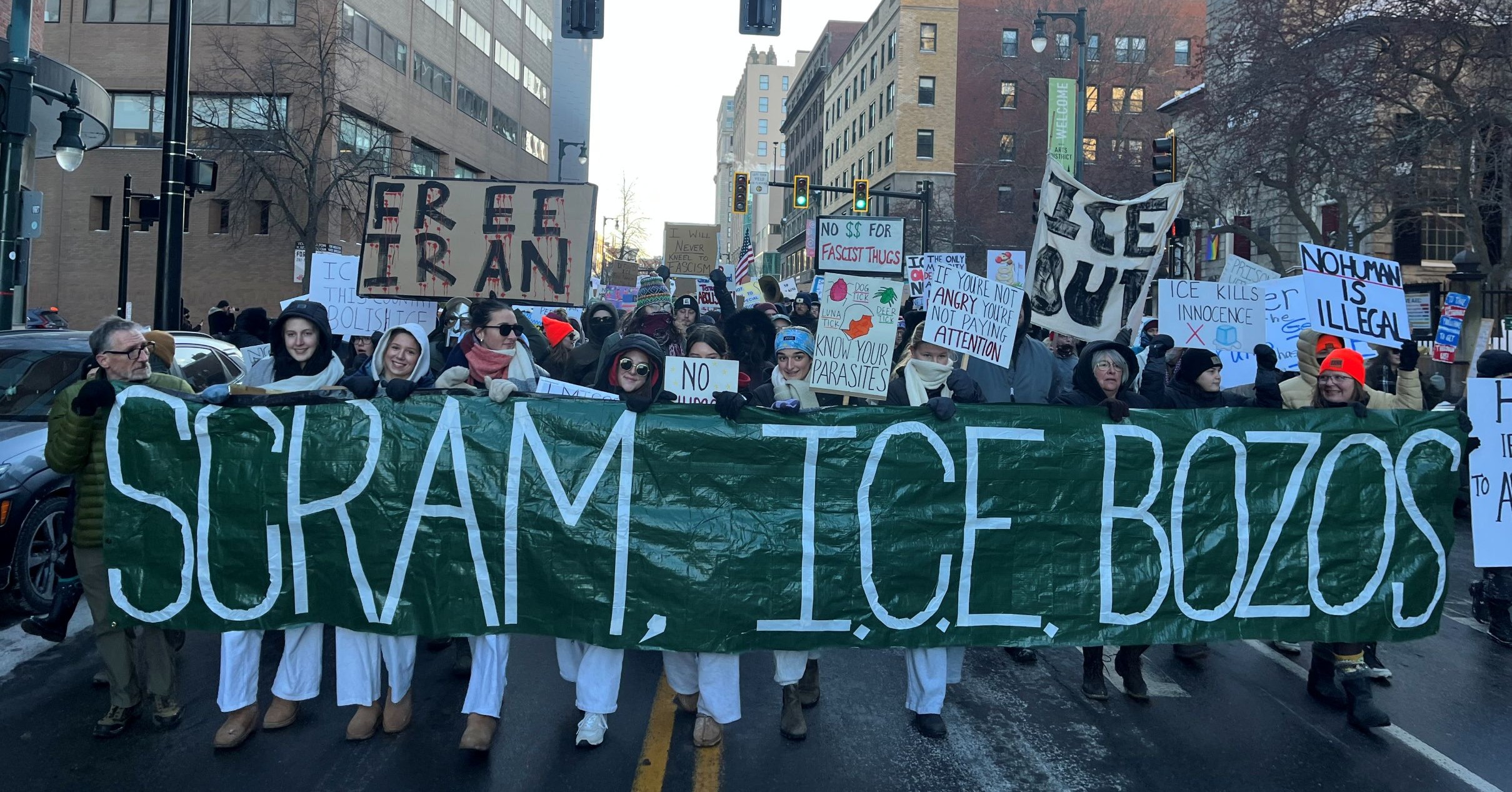
Nonetheless, January 30 was the single largest day of united action to date. The participants from the statewide organizers’ meeting on January 26 put together a morning press conference in which politicians, clergy, unions, organizers, immigrant-led organizations, and community groups all pledged mutual support for taking action. Thousands of students walked out or boycotted classes in more than a dozen towns. Twenty-five hundred people marched in Portland and 175 businesses shut down for the day in solidarity.
Now we’re dealing with the aftermath. We demand the return of each and every one of our neighbors and we are calling on the governor to enact an eviction moratorium and provide funding for lost wages and back rent. Meanwhile, educators are helping students transition back to school, the Maine Solidarity Fund is raising money to cover bail and legal costs, the Immigrant Legal Advocacy Project has staffed up and is representing many of those detained, and School Watch volunteers are moving into mutual aid and plans for the next round.
ICE and CBP are not gone. We expect them to plan kidnapping operations, but most likely in ways that make it harder for us to respond. They are cowards, so they will work at night and in more rural areas. They will hunt our friends. And we must prepare that they will come back in force if Trump wakes up on the wrong side of the bed. But we are better organized, more determined, and wiser. A keen awareness of the damage the immigrant community has suffered tempers any mood of confidence and celebration.
On Saturday, February 7, No ICE for Maine pivoted. What was going to be a mass meeting of thousands to announce escalation plans against ICE turned into a skill share and training day for 400 organizers. That day was marked by a determination to drive ICE out of Maine for good. In addition to the pressure of rapid response and mutual aid—ICE and CBP detained 17 farmworkers and a Brunswick High graduate as this article was written—No ICE for Maine and the larger cooperating forces have to think through our strategic focus as well as our internal and inter-organizational structures in the coming weeks. Although it is very difficult to do so, coming to working agreements around these medium and long-term questions cannot be postponed indefinitely.
ICE must be abolished. At the same time, no one wants to go back to the status quo. As one union organizer put it, “ICE out! Healthcare and housing in!” Intentionally strengthening our bonds and our mutual solidarity will take persistence, organizations will have to develop trust, and we will make — and have made — our fair share of mistakes. But Maine is in the fight and we’re not backing down.