
New York City DSA is currently holding a chapterwide election for leadership of its Anti-War Working Group (its Organizing Committee or OC). The election has picked up an inordinate amount of attention for a single working group election in one chapter, with multiple tendencies publicly endorsing their preferred slates and weighing in through national social media channels. We believe our chapter’s majority caucuses, Socialist Majority and Groundwork, have pursued a myopic course that will prove woefully ineffective in building a strong anti-war movement.
The basic facts are not in dispute: the Working Group held its own leadership elections in February, but 40 of 129 submitted ballots were blank. Because the Working Group’s bylaws require candidates to receive a 65% approval threshold to be seated, the blank ballots prevented all six candidates from qualifying for service on the OC.
The chapter’s Steering Committee, arguing that a lack of consensus in the Working Group’s membership necessitated larger chapter intervention, mandated a chapterwide election for its leadership. This is in contrast to every other Working Group in the chapter, where the body’s participants select their leadership from amongst themselves.
Supporters of the Steering Committee’s decision, including both the chapter’s cochairs, later distributed an open letter accusing the Working Group’s leadership of “electioneering” — sending an email to their membership saying they believed the blank ballots were coordinated — and of fixating on “cosponsoring rallies and actions led by other groups rather than build chapter rapid response capabilities.”
Like many debates in DSA, the controversy has raised substantive political questions that have been underdiscussed due to litigating procedural issues like working group bylaws and accusations of electioneering. We believe it is important to put politics first and highlight the important political questions at play.
First Issue: What Is a Membership Body?
Unlike most chapters, NYC-DSA does not have chapterwide general meetings. Members instead belong to geographic branches based on where they live, each with its own leadership and monthly meetings, and larger decisions are made by the Steering Committee and Citywide Leadership Committee (CLC).
In practice, because branches receive no funding and are constantly asked by the chapter’s priority campaigns to promote their events, branch meetings often resemble pep rallies with a series of campaign announcements and sign-up sheets but little in the way of organic political discussion.
The result is that members are typically steered into Working Groups organized by issue area, which become their primary sites of activity. Members often consider groups such as the Ecosocialist Working Group, or the Tenant Organizing Working Group, or the Anti-War Working Group their actual political homes in the chapter.
Before the pandemic, these bodies often operated as small chapters themselves, holding monthly membership meetings and deliberating on strategy, political orientation, and next steps. The chapter thus has a history of acting as an archipelago of disconnected membership bodies, rather than a single coherent one as in most DSA chapters.
The rise of Zoom meetings during the pandemic and the later push for asynchronous decision making, branded as “One Member, One Vote,” have changed the culture of the chapter. For example, the Electoral Working Group no longer holds monthly membership meetings at all, holding only periodic membership forums and mass calls on topics selected by leadership and holding endorsement votes asynchronously, rather than at endorsement forums. The Labor Working Group holds general membership meetings quarterly, but no decisions are made at them. The Anti-War Working Group, however, acts more like working groups did before the pandemic. It holds monthly membership meetings where members can bring resolutions, debate, and drive the body’s decisions.
What constitutes a membership body is the critical dispute at play. A number of the members who sent in blank ballots are people on the working group’s mailing list who have not attended any of the meetings or taken part in its internal decision making. To them, they are every bit as much “a member of the Anti-War Working Group” as anyone who has. It is an extension of the culture engendered by asynchronous decision making. To the working group’s active membership, they are not, because they have never made it a point to experience democracy and organizing activity within the body.
We believe the former view is misguided. We want members in DSA and in our unions to experience democracy as a process of collective decision making, because as socialists, we believe the working class must govern itself collectively, and socialist organization requires giving membership bodies the ability to actively govern themselves. Without the power to make decisions on their own as basic as who their leaders are, the chapter threatens the ability of bottom-up membership bodies such as the Anti-War Working Group to even exist.
Second Issue: How Should the Majority Treat the Minority?
As a consequence of NYC-DSA’s nature as an archipelago of disconnected, issue-based working groups, the chapter’s organizing bodies are prone to becoming dominated by a particular tendency or theory of change. It is a very foreseeable phenomenon when members are self-organizing based on their issue interests. Members of the Ecosocialist Working Group, for example, were instrumental in forming the Groundwork caucus, and the working group is still regarded as a Groundwork stronghold.
It is no secret that the Anti-War Working Group is considered a “left”-leaning working group by much of the larger chapter, in which the Socialist Majority and Groundwork caucuses control the majority of leadership positions. As the March 11 open letter points out, the Working Group’s leadership has had strong disagreements with the chapter’s Steering Committee regarding how NYC-DSA should orient to street movements, most notably in asking the chapter to endorse rallies with the Party of Socialism and Liberation (PSL) and the ANSWER coalition despite the chapter leaders’ concerns over negative media coverage.
It would be mistaken to argue that the Anti-War Working Group should be allowed to act unilaterally on behalf of the chapter, but it does not. The working group makes requests to sponsor events the Steering Committee does not want to sponsor, Steering tends to refuse their requests, and the working group does not officially sponsor them. The argument in the open letter thus implies that a subordinate body even criticizing a higher one is problematic.
This is where the Steering Committee’s decision becomes self-defeating. Our chapter’s Working Groups and committees select their own leadership because members in any given work area are unlikely to follow leaders they feel were imposed upon them. With a brand new war in the Middle East and escalating American saber-rattling towards Cuba, our task is to maximize the number of people willing to put in hours of unpaid, challenging, and often emotionally draining work.
If opening up the Anti-War Working Group leadership elections would induce a significantly higher number of members to engage in anti-war work, it might be an action worth considering. No evidence has been offered that this will be the case. In fact, the likely outcome is disengagement and demoralization by the working group’s most active members.
Third Issue: What Can We Do Differently?
Outside of the open letter, very few arguments have been made publicly for why the Anti-War Working Group is being singled out. Anecdotally, members and supporters of the majority caucuses have made two primary justifications in casual conversation:
- That the Anti-War Working Group’s Signal chat is annoying. Socialist Majority and Groundwork members who post in the working group’s general chat are typically met with a flurry of responses which resemble a pile-on rather than a meaningful discussion. Members of the two tendencies have cited this as a reason why they do not want to engage in the working group, and why the larger chapter must intervene to make it a more multitendency space.
This conflates the general chat with the working group itself. Its internal life is defined more by its monthly meetings and subcommittee working meetings than by a chat where many supporters in the working group’s orbit make up its loudest voices. It also fails to consider that without avenues for political disagreements in branch meetings, publications, or any other channel to express political disagreements productively, chapter members are unable to broadcast their politics in any way other than through yelling into a group chat. It is a problem and greater moderation is warranted, but it is a problem of the chapter’s own making.
- That the working group is “ultraleftist,” and installing new leaders would allow for a “mass politics, majoritarian” approach. This viewpoint is best expressed on Bread & Roses member Eric Blanc’s blog, which often posits that practices including “performative radicalism, heated rhetoric, and deference politics” compromise our ability to win majoritarian support against American warmongering. It is also a theme of the open letter, which accuses the Working Group of being more interested in endorsing PSL protests than in building DSA’s own infrastructure.
We believe this attitude is indicative of a lack of engagement with the Working Group. Many of its members self-identify as “DSA centrists” and are more focused on getting union members talking to their coworkers about the need for an arms embargo and researching municipal policy than the importance of street protests.
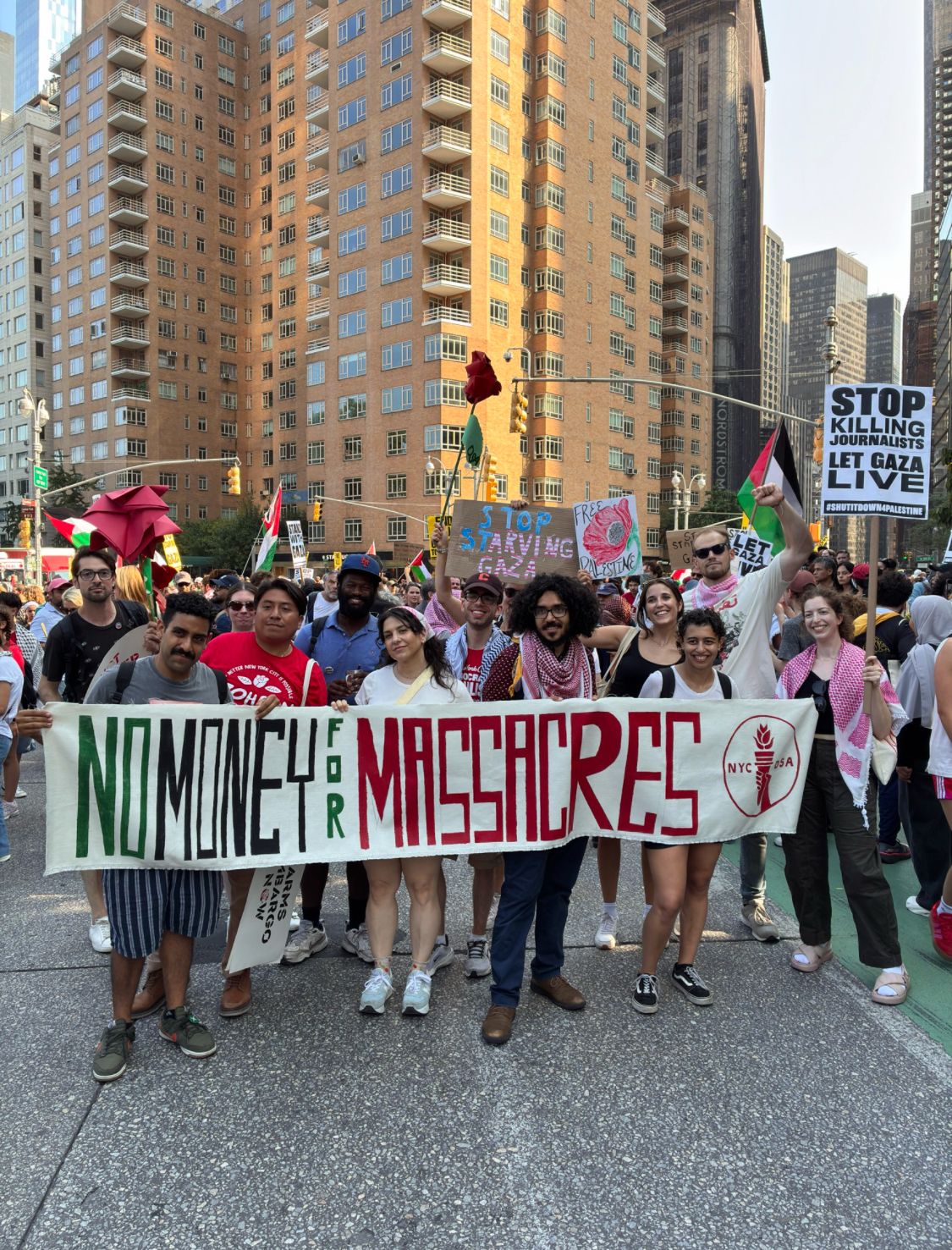
Recent calls for DSA to “lead the anti-war movement” and “build its own rapid response infrastructure” further betray a lack of understanding about the work. What groups like PSL have is the ability to garner protest permits and make signs within twelve hours of a major event. What DSA has is an engaging mass membership infrastructure and ability to plug people in to longer-term organizing projects. Simply being willing to show up at other organizations’ protests and meet everyday New Yorkers on the streets would be far more beneficial to DSA’s bringing people into important organizing campaigns and projects than it would be to PSL or ANSWER. The alternative, trying to make an “in-house” street protest operation, would be a capacity drain and pivot for the chapter to the point that proposing it resembles live-action role play.
We believe minority tendencies in the chapter must be integrated rather than shunted aside. The “ultraleftists” that many members are eager to marginalize make DSA stronger, not weaker. The chapter has many members who canvass for electoral candidates while also organizing mutual aid in a branch Community Solidarity Committee, or work on legislative campaigns while organizing tenant associations. We want a DSA which is more than the sum of its parts, in which its components reinforce each other. In practice, this will mean chapter channels through which dissent can be expressed openly and democratically, including more than two tendencies on the Steering Committee, and an attitude of synthesis rather than dismissal. Instead of asking “how are these people wrong,” we should be willing to ask how the contradictions between our ideas can form new ones. It will not be easy to accomplish, but then, neither will achieving a socialist society.
While we do not have consensus as a local caucus regarding formal endorsement, we encourage members to pay attention to who has actually been involved in the chapter’s anti-war work and to cast your votes for them