
What does a thriving Democratic Socialists of America chapter look like? We propose that robust political education and a vibrant democratic culture are necessary to build an organization of committed socialists that can act in the world.
First, what’s the reason to have a DSA chapter at all? It’s not just to create a community of like-minded people, though that’s part of it. It’s to create an organization that acts in the world with power. We are part of a national organization that’s trying to do the hardest thing ever attempted: to break the back of capitalism at its very core. To do that we will need to convince millions, literally millions, of people to become political actors in ways they never have before.
Socialism won’t be achieved by such millions obediently following orders. It can be achieved only by millions of thinking people who’ve decided to take their lives into their own hands. They will need to know that they are socialists.
The party DSA is trying to build is one school for training up socialists and class fighters. Unions can be another such school, as can social movements like the movement to stop ICE. These organizations, formal or informal, are where people learn to make decisions democratically, to strategize, to understand their opponents’ weaknesses and how to win small victories on the way to larger ones.
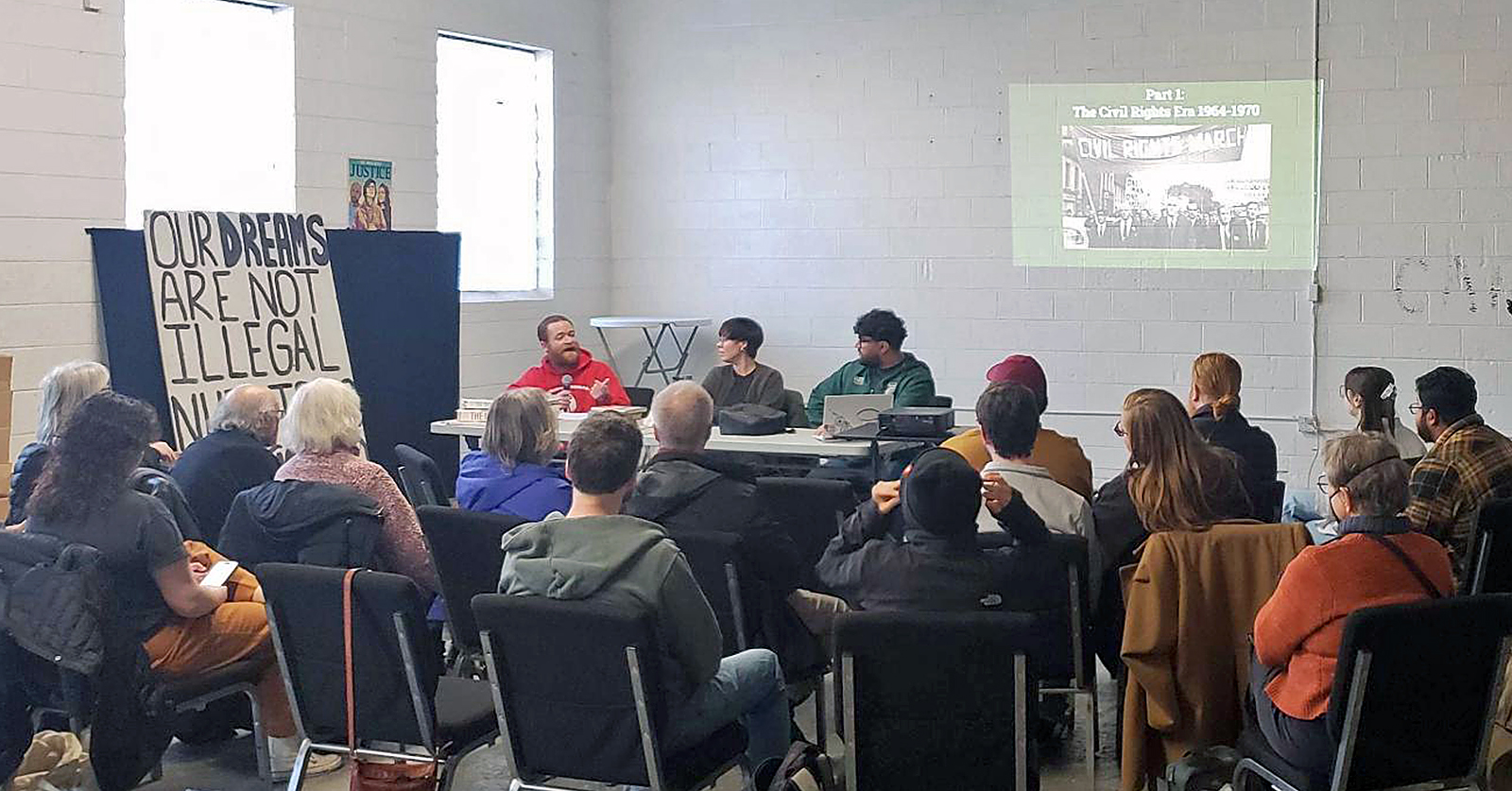
We’ve been members of Detroit DSA’s Political Education Committee since its early days. The committee has always been open to any member, and has put on a wide variety of events: education at the monthly general meetings (a new focus of the last two years); stand-alone Socialist Night Schools such as on Detroit politics, lessons from the Chicago Teachers Union, and the Communist Manifesto; Red Squares — one-off forums on a variety of topics, including conversations with socialists in (or near) office from Detroit to Brazil, and the history of the Troubles in northern Ireland; skills training such as public speaking or organizing conversations; new-member education on the basics; reading groups ranging from Capital to queer feminism to fiction. The events have been a mixture of practical, such as Organizing 101, and bigger-picture. Both are needed to help nurture socialists who can think, debate, and act. Acting in the world is the end goal of it all.
How Should DSA Function?
What’s the best way for a DSA chapter that wants to end capitalism to function? This is the ideal, which we can’t say we’ve achieved yet:
(1) High-trust, high-participation. We need regular general meetings (GMs) that people come to because they have a stake in the outcome: They learn. They debate. They vote. They make decisions that matter for what we do in the world. A GM where members’ role is to passively listen to announcements and updates… doesn’t make them want to return. Nor does it move us forward in changing the world.
(2) Active committees that have the experience and confidence to try new things. Many members’ first experience with active participation and democratic decision-making begins at the GM. An active committee is another place where those skills are honed. Ideas, decisions, and projects flow from GM to committee to GM for decisions, developments, and debriefs. Members who are involved and engaged with a committee will necessarily feel more involved in the organization, and confident in themselves. This includes the confidence of their fellow members, in and outside of the committee — they don’t need constant monitoring.
(3) Long-distance runners. People who understand how capitalism works, how movements work (or have not worked in the past), are more likely to stay in the fight. The chapter welcomes everyone who joins because of a particular issue they’re fired up about, and we help them see how it’s connected to every other issue. Conversations about systemic forms of oppression, revisited over time with new and old members, inform our strategy in our campaigns, projects, and workplaces. It is through conversations about the absolute basics that we can start to recognize the systems we are fighting. People who don’t really understand the system can get easily discouraged by setbacks or turned off by the inevitable disagreements among socialists. We must be strategic in order to make real systemic change, not just reforms. Members who inflate the potential of a particular goal can find themselves disappointed when it doesn’t meet their expectations; by understanding the system, we know that “tax the rich,” for example, is a necessary reform, but it will not end capitalism. Knowing that this is a long, monumental project gives us perspective. We see campaigns and projects as pieces of a much bigger picture. We have long-term vision and goals, and are not easily deflated by a defeat today or tomorrow. The defeats are a part of a larger experimentation. We learn, like socialists before us learned.
(4) Our campaigns are aimed at helping working class people to organize on their own behalf, not on looking for a charismatic savior. We know that a reform gifted from above is not half as valuable as a reform wrested by mass action. Our campaigns are designed for bottom-up participation and decision-making, not for marching orders.
(5) As Kwame Toure explained at a recent Metro Detroit DSA General Meeting, we are building organizers, not just mobilizers. We want ongoing, thriving organizations that people take responsibility for maintaining, not just one-off demonstrations or events (though those are important too). Toure said, “People instinctively love freedom… But you cannot win freedom on instinct. You can only win freedom on reason.” Capitalism creates a complicated, contradictory world. Socialists must be very intentional about learning and teaching the history and theory of our movement and class. This will not be done by anyone else, and it will not be done incidentally. We must make it ourselves.
How Does Democracy Help?
An undemocratic organization is a weaker organization. It doesn’t have the buy-in of its members; it has trouble turning people out for the priorities it has decided on, partly because members didn’t have much role in those decisions (even if they nominally voted for them). Socialists are in favor of democracy in their own organization because democracy leads to more unity in action.
General meetings should include political education on topics that are broad and foundational. What will help us understand the capitalist system around us, and what are the core debates in our organization? While we experiment with different learning styles, our focus is on bringing members together in conversation, to learn from each other. We do not believe that any one tendency or strain of socialist thought has all the answers for every situation. Instead, the power comes from all tendencies working together, debating and aligning on the best tactic or approach for each situation.
We’ve been misled by our civics textbooks and other forms of propaganda to think that democracy equals “you have a vote.” But in fact, democracy is much more than that. Citizens of Russia and Hungary have the right to vote, but those countries are in fact dictatorships. Political scientists call the United States a democracy, but as socialists we know who is actually running the country.
Democracy requires much more than receiving an email in the privacy of your home and clicking the box for ‘yes’ or ‘no.’ Democracy means the members run this organization. Some hallmarks:
- DSA is “we,” not “they.”
- Issues are discussed openly. Decisions are made openly. Dissenting views are encouraged. The culture is mutual respect.
- Members can organize themselves, without waiting for assignments.
- Members, including longtime members, are constantly learning.
- It’s easy to be active and to move into leadership positions.
- Leaders help new members to develop and there are multiple avenues for doing so.
- Leaders trust members and members trust leaders.
DSA since its revitalization of the last ten years has always prided itself on being a “big tent” where different views can co-exist democratically. We have rejected the idea that one set of ideas or one caucus should “win” and stamp out others.
We still have work to do to ensure that our organization fully lives up to its democratic potential and that our members are engaged, confident, and ready to act in the world. We think this is work worth doing.
A version of this article originally appeared in the Detroit Socialist.