
Several months into the second year of his second term, Trump’s might-makes-right strategy, at home and abroad, has spurred more mass disgust among his opponents and even among a few previous supporters. But does that mean Trumpism is in decline? As we confront the need to build an anti-war movement, resist ICE repression, and defend civil liberties and voting rights, it’s useful to think through our political opponents’ strengths and weaknesses. In a previous article, I suggested three scenarios that might play out in the next few years. This piece looks at the strengths and weaknesses of two of them: Clintonism 3.0 and Trumpism 3.0. (The third, AOCism 1.0, will be the focus of the next piece!)
Old wine, old bottles
Clintonism is the rule of centrist politicians who believe in neoliberal, international free trade, a moderately funded welfare state, the rule of law within the framework of mass incarceration, and market mechanisms to mitigate climate change. They tolerate unions and nonprofits, but believe that anyone to their left is “unelectable.” They yearn for a return to bipartisan normalcy where elite “adults” run the government and dominate the global economy through “multilateral” (i.e., Western) banking relationships and military might. Although it’s hard to remember now, the Republican Party used to sing a version of the same song.
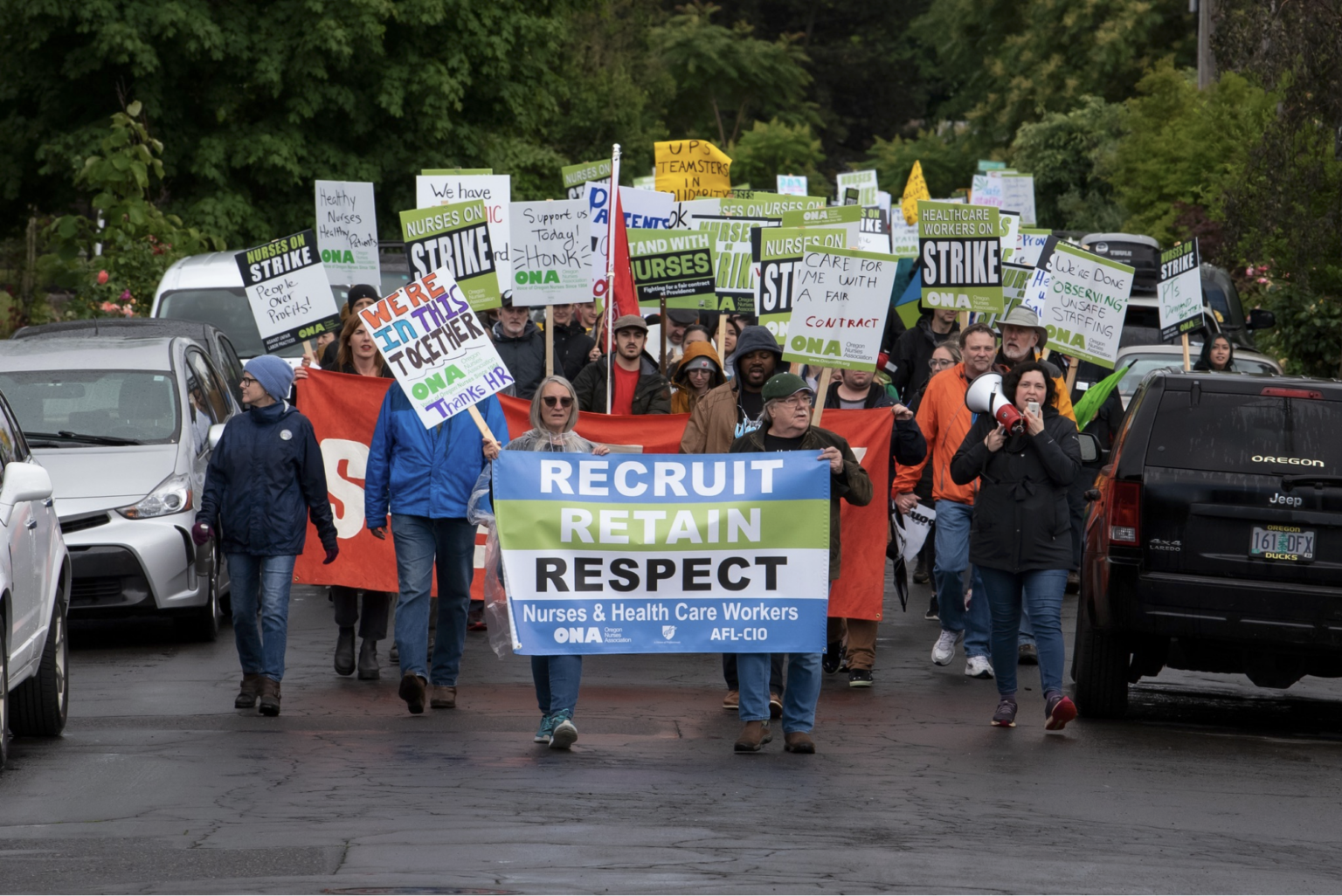
The most important factor in the power of Clintonism is the lack of an organized, working-class political alternative. Social movements and unions — and working people in general — have suffered forty years of bipartisan neoliberalism. The percentage of workers who have a union and who are confident enough to strike — the most basic measure of working-class clout — both remain near historic lows. In 1970, unions represented nearly 30% of workers. Today that number has slipped to 10%.
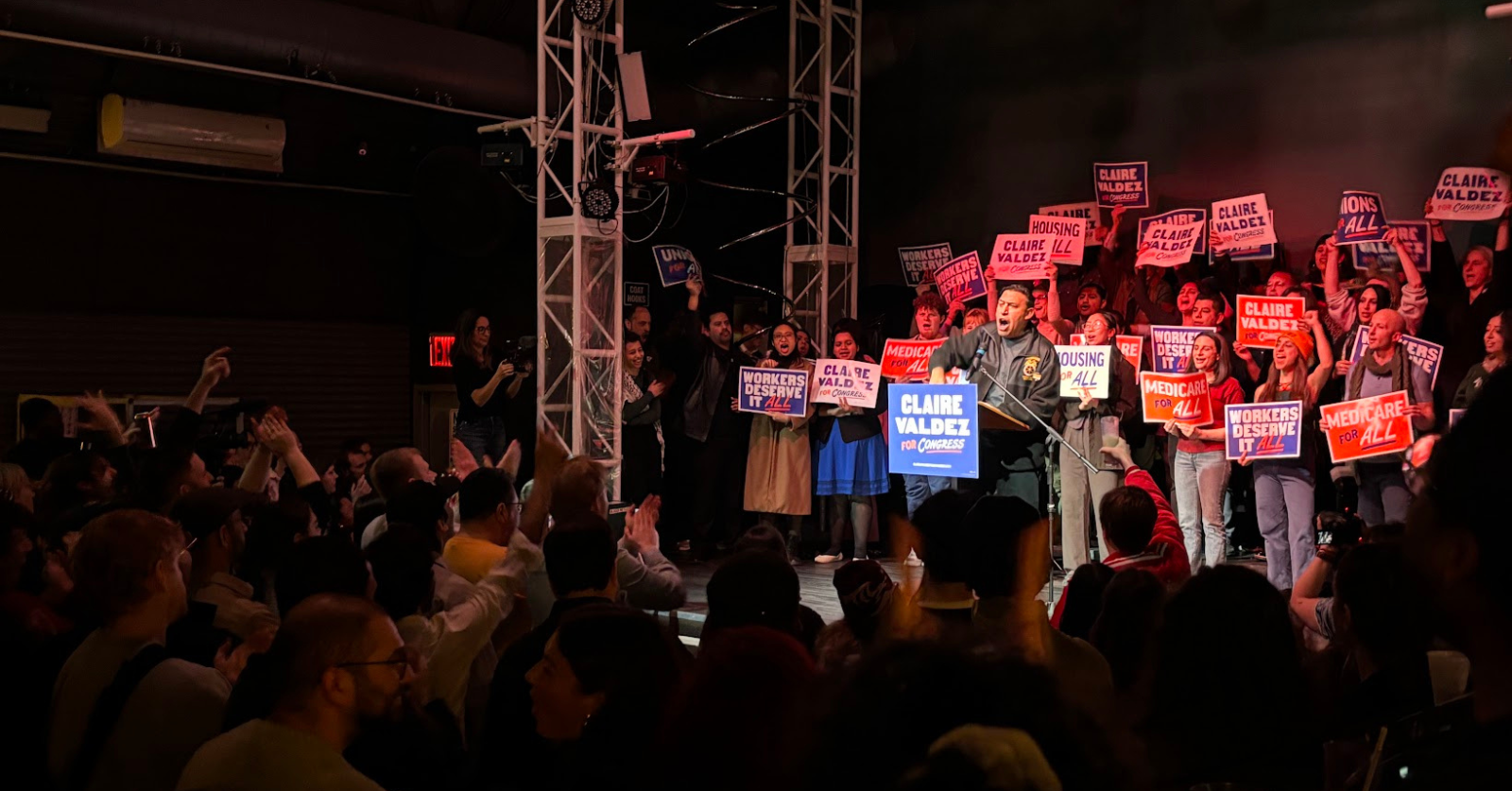
That 7 million people attended No Kings rallies in October indicates widespread rejection of Trump among an important segment of the population, but that power remains only potential. For instance, while communities in Chicago, Los Angeles, Minneapolis, and Maine have stood up to ICE and slowed down their operations — no doubt saving many families from detention — the body snatchers continue to operate with impunity. Democratic leaders in Congress like Chuck Schumer and Hakeem Jeffries want ICE agents to attend a few sensitivity seminars in exchange for re-upping their funding. Clintonism 3.0 hopes to displace just enough Republicans to win a majority in Congress and begin negotiating with Trump.
This makes Clintonists a weak force against Trumpism; however, they have huge reserves of power and money and just might pull it off. Critically, despite their own low polling numbers, establishment Democrats’ political theory — namely, that capitalism is just fine, it simply needs to be modified to reduce the worst outrages — is widely held among large parts of the electorate. A centrist return to power will be felt as a huge relief for many. But that would hardly end the crisis. A Democratic majority in one or both houses of Congress will only raise the stakes for MAGA while doing little or nothing to improve the lives of the vast majority of working-class families. Trump is not afraid of Clintonism. He proved that by defeating Biden/Harris/Walz handily in 2024.
What is MAGA?
Trumpism represents a new political phenomena: namely, a specific version of American fascism. Stefanie Prezioso warns us that knee-jerk analogies between the contemporary far right and earlier fascist movements “may risk anchoring us too firmly in interpretations of the past, hindering a rigorous analysis of today’s realities and the development of effective responses.” We should listen to her. At the same time, the human brain has used analogy to good effect over the years: If that animal is a different color but almost as big as a bear, if it doesn’t growl but it does howl, if it’s hunting in a pack instead of on its own… I should probably get out of here! This kind of thinking can be life-saving.
If Hitler and Mussolini represented fascism coming “from below” (through a mass fascist movement) and Chile’s Pinochet and Spain’s Franco represented fascism coming “from above” (through military coups), all four constructed similar regimes once in power. But the specific character and ferocity of these fascist states was shaped by their social bases and the particular political crisis that brought them to power.
There are obvious parallels between earlier fascist movements and regimes on the one hand and MAGAism and the Trump administration on the other. Fascists — and this distinguishes them from ordinary conservatives — insist they are fighting for “the little guy” and often powerfully criticize aspects of capitalism because they want to build a cross-class, mass movement.
But fascists are not consistent anticapitalists. Their goal is not to build an international movement of working-class people against global capital. Rather, they seek to build an alliance between “good” nationalist capitalists and “productive” people (workers, small businessmen, professionals, etc.) from the dominant racial or religious groups who share their supremacist ideology. To do so, they must find scapegoats. Capitalists per se are not the enemy, only “disloyal” capitalists are. Hitler blamed German capitalism’s real crisis on imaginary culprits: Jewish capitalists (and Jews in general) and the Versailles Treaty. Trump blames American capitalism’s real crisis on his own imaginary culprits: immigrants, the Paris climate accords, etc.
The fascist story can provide a powerful explanation for millions of people who want something different for themselves and their children. As Leon Trotsky put it when describing growing support for Hitler, “Despair has raised them to their feet and fascism has given them a banner.” This is what gives Trump his power, and until that story can be replaced by a more compelling explanation from the left based on strong unions, multiracial solidarity, and material reforms that change workers’ lives for the better, MAGAism will remain a strong force in American politics.
Despite his sagging poll numbers, Trump’s power is not limited by normal electoral mechanisms. The results of elections — real or imagined — still matter a great deal to MAGA, because Trump cannot yet dispense with the formal levers of state. That’s why the administration is putting so much effort into gerrymandering. But Trumpism is more than a right-wing electoral machine; it’s an inchoate fascist movement attempting to turn the state into a fascist instrument for repression.
If previous fascist movements in Italy and Germany first had to build an armed, mass movement powerful enough to destroy their enemies (unions, left-wing political parties, etc.) in order to then take over the state and wield its power, Trump has turned the map upside down. He has built a certain kind of movement, but his real political genius (stable or otherwise) is based on two realizations.
First, Trump understands that the institutionalized democracy represented by the American federal state was so corroded by Clintonism that he could simply bully it aside. In this, he learned from India’s Modi, and he is teaching France’s Le Pen. As Ugo Palheta notes, “In France, the civil liberties and social rights won by the working class and its organizations over the last two centuries have been worn down by a series of governments. The traditional mechanisms of parliamentary democracy are systematically undermined, marginalized, or hollowed out by the ruling class itself, in favor of unelected bodies or procedures to circumvent its processes.”
Second, Trump won over the billionaire class. Three generations of oligarchs grew up and prospered under Clintonism — even as they dismantled the New Deal and the Great Society — and they could not understand why anything should change. As Hillary Clinton famously insisted, America was already great for them, why rock the boat?
Fast forward to 2026: They now realize they were suckers to let any crumbs (progressive taxation, regulations, global trade rules, etc.) fall from their tables. Trump kicked open the door to unfettered AI development, military spending, a drill-baby-drill fossil fuel revival, and stunning tax cuts, paid for by robbing Medicaid. So far, Trump hasn’t needed a well-disciplined, volunteer fascist army or a military coup to wield state power.
With the state and billionaires in his pocket, Trump has transferred hundreds of billions from the working class to the ruling class through tax cuts, turned up the thermostat for global warming, and launched a new round of military misadventures. Trump’s rage against Chief Justice Robert’s decision to strike down part of his tariff policy shows that he intends to bend any remaining institutional barriers to his will. To do so, he will need a weapon his fascist forefathers wielded — that is, an extralegal military force to break through the limits of legality to authoritarian lawlessness and brute force.
The old Confederacy needed the KKK to smash the post–Civil War Reconstruction era and impose Jim Crow. Hitler needed 3 million members of the SA and SS to destroy the unions. Franco needed his bando franquista to destroy the Spanish Republic. Where is the Trump-Bannon-Miller MAGA militia?
The Proud Boys and the tangled mess of squabbling wannabes must be a disappointment. Trump pardoned them all for January 6, and they still failed to make anything of themselves… yet. And herein lies Trump’s key weakness: his base remains essentially passive. Trump’s MAGA crowds want America to be great again, but they do not want to have to make it great themselves. They want it done for them. To revise Trotsky’s comment about fascism in Germany, “despair has raised them to their keyboards, and Trump has sold them a brand.” The core MAGA belief is “don’t tell me what to do.”
Steve Bannon wants a white Christian nationalist volunteer army of a million willing to fight for the fatherland. What he has at this moment is a band of hostile snake oil salesmen. Their voices are amplified by right-wing media funded by billionaire ideologues, but they remain (so far) unable to march.
So if Trump does not yet have the extralegal ground troops to force through his extralegal desires, how can he remedy this shortcoming? Three letters: I.C.E.
According to the Department of Homeland Security, ICE hired 12,000 new agents in just four months in 2025, bringing its total force to 22,000. Although that force remains small as a percentage of the total 750,000 armed law enforcement personnel in the U.S., the Big Beautiful Bill allocated ICE an additional $75 billion to spend in the next four years. To get a sense of its room for growth, if each new ICE agent costs taxpayers approximately $100,000, that means 10,000 new agents costs $1 billion. In other words, there is plenty of money in their piggybank to hire masses of agents. And there can be no doubt that they will be recruited from the far right.
What will Trump do with such a force? Clearly he will intensify his war against immigrants and civil liberties. He aims to normalize ICE invading cities and towns, rampaging for weeks or months, and then withdrawing. All the while, ICE will dole out favors and funding to local and state police who learn to play the new game. Indeed, this process is well underway in many of the deepest red states.
But it seems foolish to assume that Trump will stop at street terror. He still needs the formal levers of state power to stay the course. He may chafe at the Supreme Court and internal squabbles in the GOP, but he is not yet strong enough to rule without Congress, and as his prospects dim for winning a fair and free election come November, ICE looms large. Trump has already announced he wants “federal” control in 15 major Democratic cities. If he unleashes ICE in October and November to create havoc, he can claim fraud, throw contested election results to friendly state legislatures, and then fight out a Constitutional crisis. This is a playing field on which he has demonstrated he can defeat the Clintonians time and again. After Venezuela, after Iran, we must take this gambit seriously.
So how do we get out of this mess? Having assessed Trump’s strengths and weaknesses, in my next article, I’ll examine the prospects for AOCism 1.0 — leftwing electoral growth and the rise of fighting social and union movements — and review some lessons from three words that start with the letter M: Minneapolis, Maine, and Mamdani.