
The 2025 DSA convention passed “Non-Reformist Labor Reforms for Worker Power,” as an amendment to the National Labor Commission’s (NLC) consensus resolution. This amendment committed the NLC to creating and supporting “chapter campaigns for non-reformist labor reforms that, if secured, would create new openings for labor organizing, especially on the state and local level.” As DSA continues to build our bench of socialist elected officials, we need a socialist vision for labor rights — a clear platform of concrete policies that empower working-class people to further change the economic and political system.
So what is a non-reformist labor reform? How is it different from other reforms? Should we be fighting for “reforms” at all?
The relationship between reform and a revolutionary socialist horizon has been a rich vein of socialist discourse for over a century, and this isn’t the place to mine all its depths. But at the most basic level, a non-reformist reform (also thought of as a “structural reform”) is one that can be achieved within the framework of capitalism, but at the same time undermines that framework and advances us closer to a socialist future.
To translate that into concrete terms, I’ll borrow from the work of my comrades Greta Smith and Robert LeVertis Bell of Louisville DSA, who have elaborated this concept in the context of police reform, but adapt it for the labor movement.
We can think of reforms according to a hierarchy of objectives. If we believe socialists should always be at the forefront of the class struggle, this method tells us where to find that front.
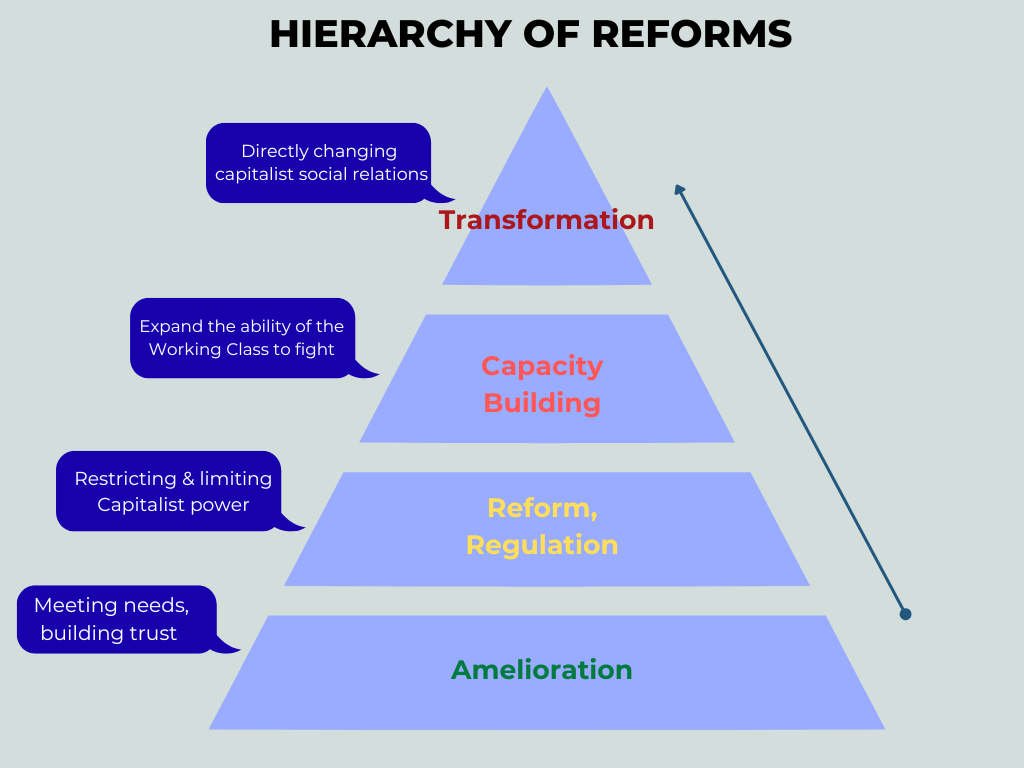
Tier 1: Amelioration
Capitalism undermines working-class living standards and leads to immiseration and material deprivation for workers. The immediate needs of the hardest-hit sectors of the working class are for improvements in working and living standards. Reforms like raising the minimum wage, requiring overtime pay, or providing paid sick leave fall in this category. These are all good things — things that liberal and progressive activists advocate for too — and socialists should support them. To do otherwise would undermine workers’ trust in the socialist movement. If we want the working class to regard socialism as the expression of their interests, then we have to show up for the struggles that most immediately matter to them.
But these reforms do not change the structure of capitalism, and on their own they don’t offer opportunities to challenge that structure. For that, we have to look at the next tier.
Tier 2: Basic Reforms
Beyond simply providing material aid to the working class, there are reforms that use state power to regulate and restrict the exercise of capitalist economic power. These reforms typically make use of the state’s police powers. Examples are laws that create penalties for retaliating against workers, that limit the grounds on which a worker can be legally fired, or that outlaw especially sharp forms of exploitation like forced labor. Winning these kinds of reforms never comes without a real fight, and usually involves large-scale worker mobilization. That fight may itself help advance the socialist movement by getting workers in motion and creating organizing opportunities.
But these reforms typically do not, by themselves, offer actual tools with which the working class can contest the power of capital over their daily lives. And they typically rely on the state to enforce the law or take further action over time to make it effective – support from a state that may be indifferent or hostile to workers’ rights. Wage theft, for example, is illegal, but the law is woefully underenforced. For more effective ways to challenge capitalist power, we have to look to the next tier.
Tier 3: Non-reformist Reforms
At our current conjuncture, this is the sweet spot. Liberals and progressives can usually be counted on to fight for amelioration or basic reforms. But our job as socialists is to find ways to change the capitalist framework in a more fundamental way. The working class is strategically positioned to fight against its own exploitation within capitalist social relations, and our job is to forge weapons to use in that fight.
Non-reformist reforms directly expand the capacity of the working class to wage the class struggle, leading to greater class cohesion and consciousness. On a national level the Protecting the Right to Organize (PRO) Act, the AFL-CIO’s proposed package of NLRA reform, has elements of this approach (for example legalizing solidarity strikes and secondary boycotts). Another example is Community Navigator Programs. They give unions and worker centers a role in helping workers access safety net programs like unemployment insurance — a change that has been shown to both expand access to unemployment insurance and increase workers’ willingness to organize and take collective action on the job. There’s also the EMPIRE Act in New York, which would allow workers and unions to to enforce worker protections directly on behalf of the state, dramatically cutting the time it takes for workers to get what they’re owed.
These reforms put new tools for class struggle directly in the working class’s toolbox. They make organizing easier to engage in and more effective. And in an incremental way, they change the relationship between state power and the class structure. Non-reformist reforms allow the working class to use state power to advance its own interests without relying on allies of the capitalist class to access that power. These reforms should be difficult or impossible for capitalism to institutionalize or coopt, and their virtue lies in being able to advance the class struggle to a higher level.
It’s worth noting that aspects of policies Tier 3 Structural Reforms can often be won as part of Tier 2 Reforms or Tier 1 Amelioration measures. For example, in Seattle, gig workers won minimum incomes (Tier 1), paid sick days (Tier 1), and deactivation protections (Tier 2), as well as an enforcement mechanism that allows worker organizations to bring lawsuits directly when there’s a violation (Tier 3). This combination builds working-class power by giving unions and worker centers a way to bring financial and public pressure to bear on employers and to reclaim some of the surplus value that capital expropriates from workers.
Tier 4: Transforming state structures
The last tier in this hierarchy lies at the edge of what we can currently envision. A true democratic transition to socialism would require fundamental changes in how the state operates — a shift in the relationship between the state and the class structure. For this to happen, socialists would likely need to win a decisive electoral mandate with supermajority support, and be supported by social movements rooted in class conflict in the workplace — enough to counter the economic power of capital.
Tier 4 consists of the “reforms” that lie just short of that transformation. They are “reforms” in the original sense of the word – in the sense that they re-form (read: reshape) the nature of the state itself by creating new levers of democratic control for the working class. Tier 4 “reforms” are transitional in nature. They not only advance working-class interests on the terrain of the state, they directly challenge capitalist social relations, bringing us closer to a rupture with capitalism. For example, a universal jobs guarantee that eliminates unemployment by putting people to work on public works projects like a Green New Deal would eliminate the reserve army of labor, weaken “the power of the sack,” and thereby undermine capitalist power to drive down wages, extend hours, and increase exploitation. They build the working class’s ability to pursue its own interests, without regard for the consequences — that is, even if it means, ultimately, ending capitalism.
While some of these reforms lie at the edge of what is immediately achievable, they can be envisioned in concrete terms, and other intermediate reforms — the kind in Tier 3 — will usually point toward them. For example, improving access to unemployment benefits softens the effect of unemployment, but a jobs guarantee would eliminate it altogether. Winning the first reform opens space to organize around the second. In this way, each step in the fight leads directly on to the next. Each step sustains but also requires working-class and socialist organization to keep moving forward rather than backtracking or being diverted into class collaborationist compromise.
The Journey and the Destination
The reforms I’ve described here don’t work in a vacuum. For this kind of approach to be effective as a strategy for advancing toward socialism, two key things need to happen.
First, the way we win reforms is at least as important as what we win. Socialists should fight for reforms that develop working-class consciousness. That can happen with any kind of reform, although it’s more likely to happen when the reforms directly attack capitalist structures. The important point is that the reforms should be won by the working class, not through cutting deals with the boss or the state. That approach would both weaken the reform itself and miss the opportunity to grow organizing capacity. And laws themselves won’t organize workers — workers will. The law simply helps extend and increase their ability to do so.
Second, any change that is won through the legal system requires ongoing engagement to be effective. Over time judges will misinterpret and weaken the law, pressure from capital can wear down the resistance of working-class organizations, and working-class militancy can ebb as well as flow. All of these effects can be easily seen in the history of social democratic compromises.
But that does not invalidate the project. Pressure has to be sustained to be effective. Few battles are ever decisive enough to win a war. But reaching the decisive point requires us to build up working class consciousness and capacity over an extended period of time. Each win should build confidence, point toward the next fight, and offer us a greater ability to take the next step. Non-reformist reforms offer tools for class struggle, but tools have to be used effectively. This is why the process of fighting for reforms is so important; organizing develops the capacity that we need to use these tools to move to the next stage of the fight.
The democratic road to socialism is rarely simple. We have few historical examples to draw from, and many negative examples from which to learn. But we can chart some of the steps along the way. Building structural reforms offers a tactical guide to a larger socialist strategy. As long as we find ourselves within a capitalist framework while fighting a war of position, non-reformist reforms are the positions we should prioritize.
If this vision appeals to you — if your chapter is in a position to support or initiate a fight for structural labor reforms — we encourage you to join or contact the Unions For All subcommittee of the NLC and help us map this road together.
Reprinted from Democratic Left