
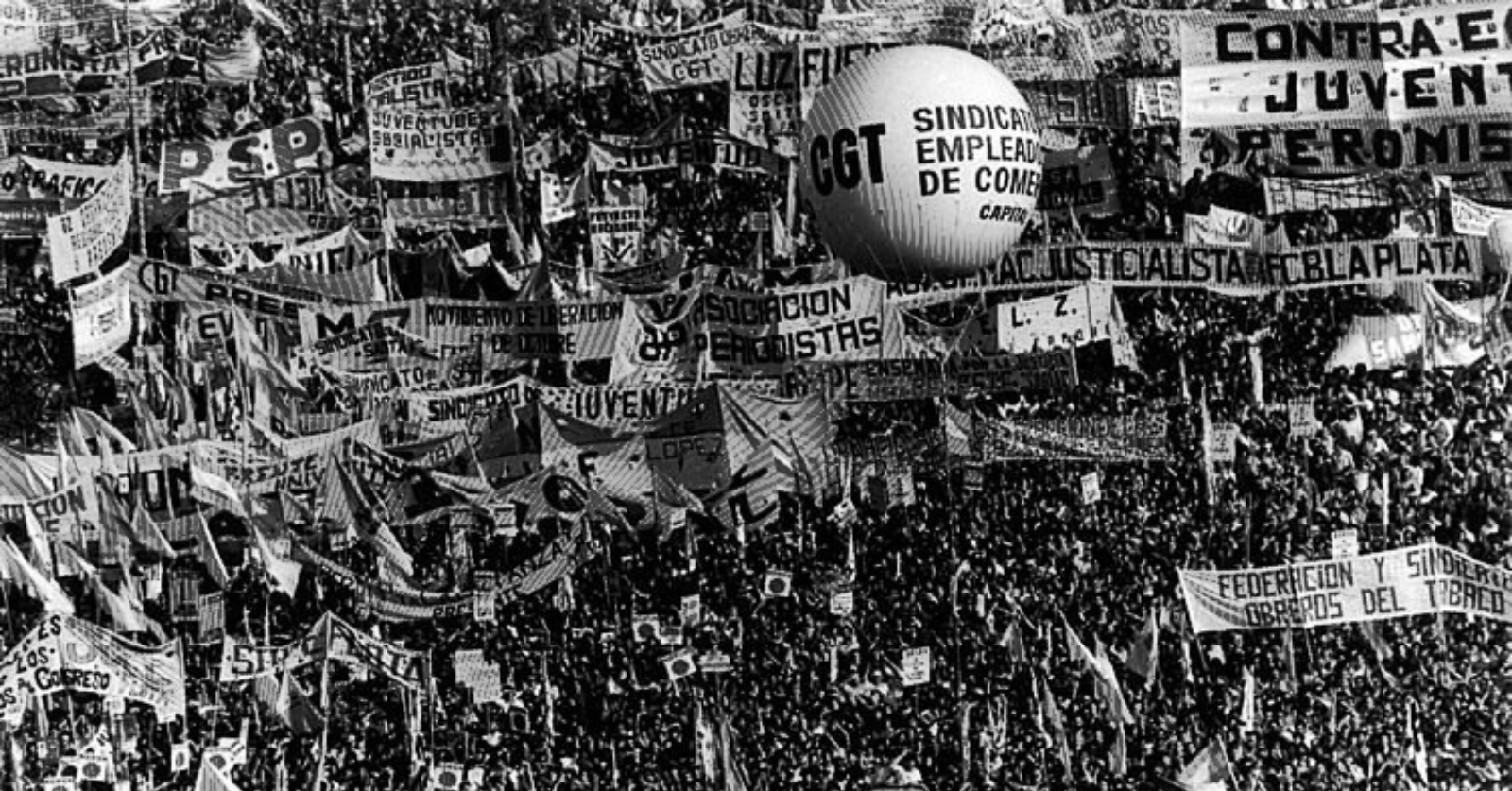
March 24, 2026 marked the 50th anniversary of the coup in Argentina that installed a brutal seven-year authoritarian regime. Below we republish an account of the resistance to that regime and its meaning for today by an activist who fought against the dictatorship as a member of the Workers Socialist Party (Partido Socialista de los Trabajadores, PST).
Fifty years after the coup, memory is not just an exercise in thinking about the past: it is a living force. As every year, thousands of workers and popular sectors return to the streets in Argentina. But this time, this act of marking the anniversary of the coup does not only look back: it is charged with current events in the face of the right-wing government of Javier Milei, that seeks to excuse the crimes of the dictatorship and reopen the debate about its genocidal actions.
It is not the first time that there has been an attempt to rewrite history or to grant impunity. The governments after the dictatorship also did so. President Raul Alfonsín gave in to the military revolt of the Carapintadas in 1987 and Carlos Menem moved forward with pardons. However, these attempts at forgiving the dictatorship’s leaders and supporters encountered a persistent resistance.
Decades later, the Argentinazo in 2001 — that great popular mobilization that ended Fernando de la Rúa’s government, when he was ousted from the presidential office building, the Casa Rosada, by helicopter — ended up creating a motto that became a rallying cry: “neither forgetting nor forgiveness.” Those responsible for state terrorism were tried and imprisoned. Néstor Kirchner’s government decided to go against the military to channel, through this means, the popular mobilization that had begun with the Argentinazo.
The dictatorship led by Jorge Rafael Videla left a toll of 30,000 disappeared people. But it also left a history of resistance: a struggle that began to take shape in 1977 with the Mothers of the Plaza de Mayo and that had one of its decisive moments in 1982, when a popular mobilization rocked the regime.
The dictatorship’s objective was also to erase the historical memory of the working class and its militant vanguard. However, this memory survived in the clandestine resistance. As I pointed out in the introduction to the book Rastros de Silencio (Traces of Silence), which compiles testimonies from Workers Socialist Party (Partido Socialista de los Trabajadores, PST) members during those years: it was the bloodiest dictatorship on the continent, but also one of the shortest, largely due to the combativeness of the workers and the Argentine people.
By around 1981, strikes and protests started to wear down the regime. Throughout this process, PST members were present, maintaining the organization under extreme conditions, supported by strong militant morale, politics, and a tradition of struggle.
The repression was brutal. It was directed against the leaders and activists of the labor movement and against guerrilla organizations and left-wing parties. More than one hundred members of the PST disappeared: approximately one in ten. Even so, the party managed to maintain its activity. It retreated to working-class neighborhoods, reintegrated itself into factories with new, underground members, and maintained its connection with the working class. Its press circulated clandestinely, hidden in the packaging of everyday consumer products.
Meanwhile, the regime began to crumble. Sectors of the industrial bourgeoisie, harmed by the economic model of the dictators, began to distance themselves from it. At the same time, the labor movement regained its prominence: the CGT (General Confederation of Labour) called for strikes and mobilizations and gave expression to an increasingly broad social rejection of the regime.
The combination of economic crisis, divisions within the ruling class, and the rise of the labor struggle weakened the dictatorship.
Malvinas: A War That Sped Up the Fall
In this context, the dictatorship attempted a desperate maneuver to regain the political initiative: the Malvinas War (commonly known as the Falklands War in the U.S. and U.K.). It gambled on international support that never materialized. For years, the Argentine Armed Forces had acted as allies of the United States in Central America, but this did not translate into US support.
The reconquest of the islands — occupied by the United Kingdom since 1833 — triggered a strong anti-imperialist mood. Broad sectors of the population supported the cause, organized mobilizations, and contributed resources. The PST actively intervened, boosting mobilization and proposing measures to confront the war in anti-imperialist terms.
But the dictatorship’s political calculation was flawed. The United States supported Great Britain, its strategic ally. British military superiority, coupled with the deficient and corrupt leadership of the Argentine high command, sealed the war outcome.
Despite the heroic actions of the Argentine pilots, the British troops managed to prevail. The surrender exposed the weakness of the regime.
The Fall: When the People Rose Up
The defeat provoked a popular upheaval. For weeks, the dictatorship had released reports claiming that the war was being won. But when the surrender became public and soldiers’ testimonies began to arrive, indignation exploded in the streets.
That same night, about 30,000 people gathered in the Plaza de Mayo to repudiate the military. In the following days, the mobilizations grew steadily. The power of the dictatorship was already shaken, and shortly afterward, its main figures began to fall.
Surrounded by popular mobilization, General Leopoldo Galtieri fled the Casa Rosada by helicopter. This opened a power vacuum that led to the collapse of the regime. It was not an orderly transition: it was the direct result of the eruption of the people.
Faced with a crisis, the bourgeoisie pushed for an institutional solution: it reinstated Parliament (which had been dissolved since 1976), formed a provisional government, and called elections.
In this context, the PST reappeared publicly. It did so with a column of more than 800 activists in the Plaza de Mayo, amidst the popular mobilization. It was a profoundly moving moment: after years of clandestine work, the activists reunited, embraced each other, and shouted together again for the end of the dictatorship.
Memory, Present, and Future
Fifty years later, these memories are not just history: they are living lessons. The fall of the dictatorship shows the decisive role of popular mobilization in the face of authoritarian regimes.
This experience connects directly with the present. Faced with the government of the neo-fascist Javier Milei — Donald Trump’s direct agent — and his attempt to reopen debates already closed by popular struggle, memory returns to occupy the streets.
It also poses a political challenge: the need to build an alternative in the face of a neo-fascist project and a “Peronism” (see also “Kirchnerism“) that, in all these decades, has demonstrated its inability to solve the country’s structural problems and end the neoliberal legacy that continues to push Argentina from crisis to crisis.