
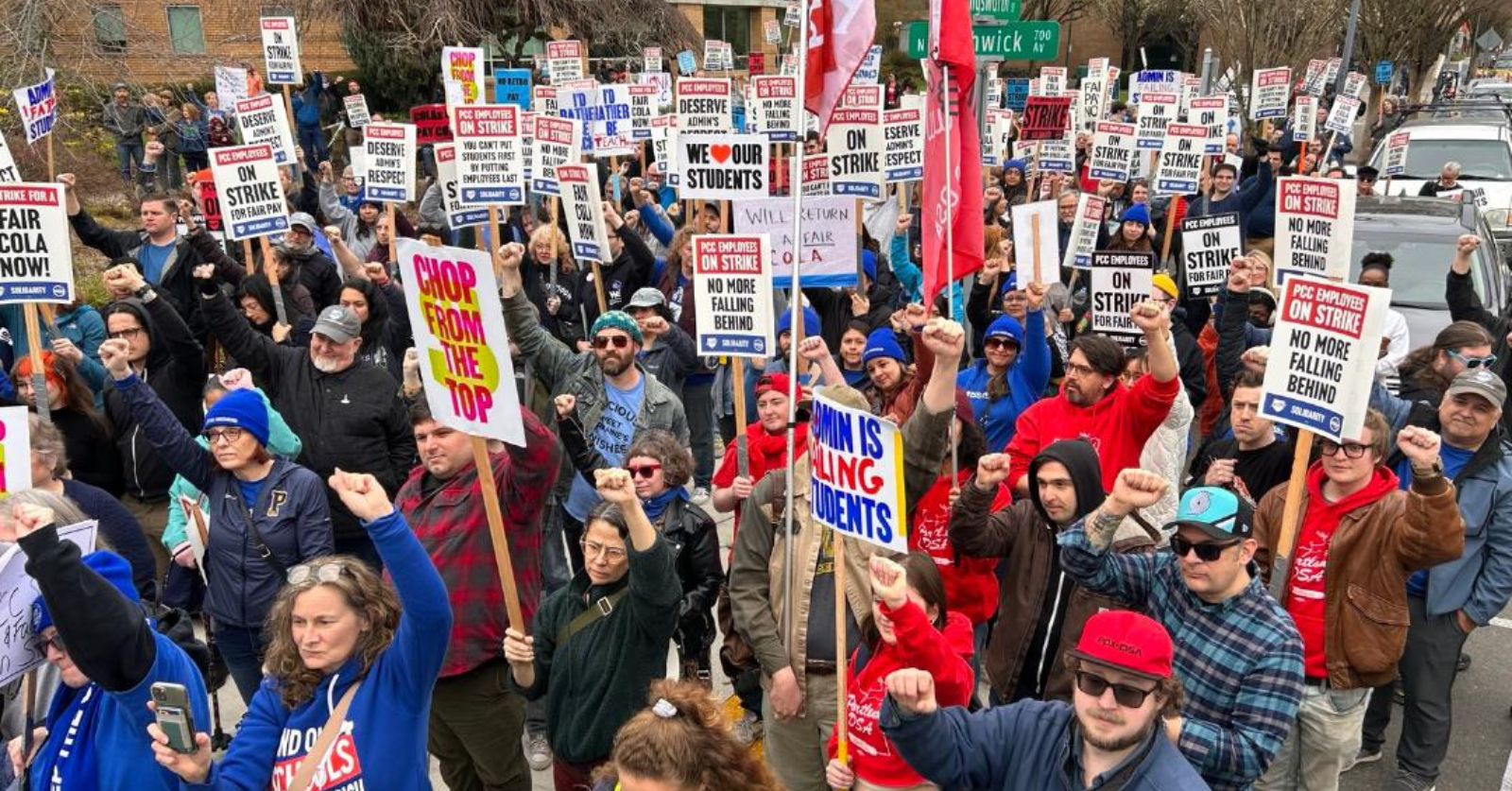
Twenty-three hundred workers from two unions at Portland Community College went on strike for three weeks in March, forcing the college to delay spring term by a week. Our strike won a respectable cost-of-living adjustment and protections against PCC’s plans to cut essential classes. Most important, it was a humiliating defeat for the entrenched top executives and board directors who were hoping to crush our unions and downsize PCC.
It was not only the first community college strike in Oregon’s history; it was also a rare wall-to-wall strike where both educators and support staff walked out together. Members from both the PCC Federation of Faculty and Academic Professionals (AFT Local 2277, representing instructors, counselors, librarians, and advisors) and the PCC Federation of Classified Employees (AFT Local 3922, representing administrative assistants, custodians, IT technicians, food service workers, and groundskeepers) worked together in a joint strike committee and said it felt like we were “one big union.”
But while it was clear to members how powerful our strike was, we repeatedly faced warnings of weakness that didn’t track with our own assessments — especially from staff from the American Federation of Teachers (AFT) and AFT-Oregon, our national and state affiliates. We heard from members of other unions who’d recently gone on strike that their strategic conversations, too, were affected by these self-defeating fallacies. These myths undoubtedly played a role in PCCFCE taking a quicker, financially weaker deal compared to the deal PCCFFAP got.
These are the misconceptions other unions should be alert to and the rebuttals we wish we’d known ahead of time.
- “Management might offer even less if you strike.”
Despite countless strikes around the country forcing employers to concede millions of dollars to workers, our bargaining teams were warned that the opposite could happen. While workers shouldn’t assume victory is guaranteed, there’s a reason it’s exceedingly rare for unions to settle for less after a strike: strikes are painful for employers, and they’ll sacrifice a lot to stop them.
PCC’s “last best final offer” to PCCFFAP before the strike was an economic package totaling $3.9 million. After three weeks on strike, PCCFFAP settled on a package worth $16.2 million.
- “We could get in legal trouble if we talk publicly about permissive subjects.”
Under state law for the public sector in Oregon, which is very similar to the National Labor Relations Act (NLRA), unions can strike only over mandatory subjects of bargaining (proposals the employer is required to respond to, such as compensation or safety) rather than permissive subjects (proposals the employer is not required to respond to, such as decisions about program closures). Our strike was over a mid-contract renegotiation of wages and benefits, which made mandatory subjects even more narrow than normal.
So how can you use a strike as leverage to win “common good” demands that are usually permissive subjects, like stopping program cuts in our case? Our bargaining teams worried that even mentioning those demands publicly could put our strike at legal risk.
The solution was simple: keep mandatory proposals higher than you expect to win (for us this meant a beefy economic package) and use that as a bargaining chip to trade for permissive subjects. In statements to the media, we made clear that we were “striking over wages and benefits” and also “fighting to protect education.”
During the strike, the PCCFFAP bargaining team polled members on this approach, asking us at an all-member forum if we would be willing to take a slightly lower COLA in order to protect classes. Over 80% said we would. When we made that commitment public, we locked in student support, which in turn cemented our members’ willingness to stay on strike as long as necessary. If we had gotten clear on this strategy before the strike began, our bargaining teams might have held on to even stronger language that we ended up conceding.
- “We should be picketing at all working hours at all locations. Otherwise, management won’t take us seriously.”
What’s the utility of picket lines? In some cases, pickets can discourage strikebreakers and customers from entering a workplace. They can turn away deliveries and maintenance crews. They can make the strike visible and boost public awareness, and they’re a good visual for media attention. They can show union strength in both numbers and resolve. They give workers a place to gather and build community, do democracy, share information, discuss strategy, and have fun. They give supporters a place to contribute by showing up, bringing food and supplies, and sharing on social media.
But pickets can also be exhausting and resource-intensive. In our strike, we didn’t need to turn away students or scabs because campuses were already mostly closed. The College was forced to operate online the entire time. We understood that our greatest asset was the social crisis of a strike bolstered by community support. So we usually picketed for three hours a day at only two of the four PCC campuses, and we skipped some days when we had other actions planned. This allowed every picket to be well-attended, well-resourced, and high-energy. During non-picketing time, we scheduled other events like planning meetings, phone banks, member forums with the bargaining team, educational events and trainings, online events for remote workers, and rallies, marches, and other demonstrations that directly targeted decision-makers. These were all absolutely essential to our victory.
A strike isn’t just one tactic – it should be its own escalating campaign. That’s very different from standing by a burn barrel all day hoping management comes to their senses. What pushes management to settle are high political and financial costs. That comes from strikers’ commitment to withholding their labor and upping the pressure over time.
- “Picket line attendance isn’t high enough.”
AFT bureaucrats were insistent that we had to keep a close eye on how many people were attending the picket line. Staff created an online sign-in form to track it. None of us knew exactly how much attendance to expect, especially because a large portion of our members work remotely, and many are part-time (adjunct) faculty who have other jobs. Over the first three days of our strike, we were elated to see over 1,100 people on the line – nearly half the total workforce despite a torrential downpour all three days! And that didn’t capture all the people who attended our daily virtual events. Pickets looked huge and felt electric, with honking, singing, dancing, student solidarity, visits from politicians, and food deliveries from other unions. It was inspirational.
But AFT privately told our bargaining teams the numbers “weren’t where we wanted them”… then didn’t say what the numbers should be or why. The implication was that anyone who wasn’t on the picket line could be scabbing, even though we knew that wasn’t the case. Member leaders were confused, some were irked. It was as if AFT reps were working backwards from the conclusion that we should settle soon, and no number would have been good enough to satisfy them.
While the sign-in records could have been one helpful data point in assessing our strength, we quickly realized that they were being used to scare our bargaining teams. (Weaponized metrics can come from not only the boss but also from inside the union, sadly.) Member leaders on our Strike Committee insisted on meeting with the bargaining teams and reps from AFT National and AFT-Oregon to discuss this dynamic out in the open. We made our perspectives clear, and although AFT continued to harp on this point in venues where the member-led Strike Committee couldn’t respond, it had less of an impact for the rest of the strike.
- “We have no way of knowing how shut down the facilities are. They could reopen tomorrow with scabs.”
It’s important to have confidence that a strike is interrupting “business as usual.” Workers should trust their own job knowledge to determine how many workers and from which departments would make the employer seriously dysfunctional. And there are major downsides if the boss wants to hire outside replacement workers – it’s extremely expensive, unpopular with the public, and rarely effective at returning operations to normal levels.
In our strike, AFT staff frequently shared anxieties about not knowing exactly who had crossed the picket line and what services could run. The college had moved into “remote operations,” meaning classes and services moved online and people could work from home. That made it possible for workers to scab more discreetly. In the absence of perfect information, the most dire predictions were voiced.
But we knew it would be virtually impossible for PCC to replace 2,300 workers in time to go forward with spring term, especially the more than 1,000 credentialed instructors. Astonishingly, management admitted this to us at the table, told the media that 85% of workers were striking, and later told students that only 30% of final grades had been submitted.
But even without those numbers, we were confident in our strike participation. Students were extremely vocal about the crisis they were experiencing, and PCC had been forced to close all the campuses – that spoke volumes about our leverage. We also launched a “Hold the Line Pledge” in the second week to renew workers’ commitment to delaying spring term if necessary. In the end, the College stayed closed until PCCFCE returned to work, and management’s botched attempt at reopening without faculty and academic professionals was the day PCCFFAP got a tentative agreement.
- “If the bargaining team isn’t available to management at all hours, we’ll look like we aren’t bargaining in good faith.”
Throughout our strike, member leaders expressed concerns about the marathon sessions our bargaining teams endured. We had daily Zoom updates where members could speak directly with the bargaining team, and some of us sensed they were getting worn down. In fact, the night that PCCFFAP conceded the strongest language on protecting classes, the bargaining team was at the table for over 12 hours and didn’t go home until 1am.
Bad-faith bargaining is hard to prove, in the eyes of both the law and the public. As long as you are trading proposals on mandatory subjects on a regular basis – which can always be done asynchronously over email – then there is no need to run yourself ragged and make rushed decisions, which is what the boss is hoping you will do. We made the mistake of shifting away from open bargaining once we entered mediation. Having members in the room could have helped our teams hold the line and preserve their energy.
- “It’s bad optics to attack the boss. We’ll lose community support.”
Even before we struck, both the College President, Adrien Bennings, and the Chair of the Board of Directors, Tiffany Penson, were widely despised by workers. Among many other transgressions, they’d offered us a 0.35% COLA, planned to cut popular programs, closed down the DEI office, refused to put up signs to discourage ICE from going onto campuses, and created a suffocating authoritarian workplace culture. But they are also black women. Portland is an unusually white city, and academia is a particularly white industry. People were understandably cautious about the implications of this dynamic, even though many workers and students were extremely vocal about wanting to hold Bennings and Penson accountable for their intransigence, austerity, and union-busting.
Then just two days into our strike, the PCC student government held a Vote of No Confidence in the College President and emailed the entire student body declaring their support for our strike and our unions. Our members quickly developed a consensus that we needed to back students up – so both unions conducted and publicized our own Votes of No Confidence.
Far from losing us community support, students and other community members were in fact horrified to learn what was really going on at PCC and were eager to know who was responsible. Targeting Bennings and Penson created media buzz that damaged PCC’s image and persuaded politicians to take our side and distance themselves from an unpopular administration.
- “Politicians won’t want to help us if we are too critical or demanding of them.”
Public support from elected officials and other visible figures is a key ingredient in maintaining the resolve of workers and undermining the intransigence of management. This is especially true for public sector workers. But most politicians won’t be motivated to take our side out of a sense of moral obligation or a desire for a mutually respectful relationship with unions. They intervene on our behalf when it’s in their best interest. That means workers need to create costs to politicians’ careers and social standing for choosing the wrong side.
We knew that Oregon Governor Tina Kotek could be pressured to play a role in getting our employer to settle. She’s a Democrat who depends on support from unions but recently failed to secure endorsements from the Oregon Education Association and the Oregon Working Families Party. In short, she had something to prove.
When we’d already been on strike for two weeks and the governor had been silent throughout, PCCFFAP wrote a press release that called on her to intervene. AFT staff and officers strongly discouraged us from publishing it, claiming Kotek would be miffed and disinclined to help us now or in the future. They were wrong. The next day, the governor made her first public statement of support for our union. After we held a press conference to call further attention to her inaction, she spent the entire weekend communicating directly with the PCCFFAP bargaining team and the PCC Board of Directors. On Monday we reached an agreement.
- “The strike isn’t working. Our power only goes down each day that we’re on strike.”
Negotiating with management often carries the illusion that the mere act of passing proposals back and forth should “make progress,” and that if it doesn’t, you need to concede. But bargaining isn’t really iterative like that.
What makes progress is leverage, built up and exercised mostly away from the bargaining table – in the public arena and through the shutdown of production. That leverage grows over time as the shutdown becomes more costly, political scrutiny heats up, and workers at other workplaces become inspired to demand more of their employers, too. Although the pressures on strikers (like lost wages) also grow over time, it’s possible to mitigate or overcome them, by raising money and keeping spirits high. After our strike, we heard many workers say things like, “I lost money on this strike, but I’d do it again in a heartbeat. Let’s start growing our strike fund for next time.”
Anti-union consultants advise employers to pound home the illusion that the fight is futile. PCC repeatedly gave us a worse offer after each major escalated action we did – what could be more demoralizing? But eventually PCCFFAP got nearly everything we’d been holding out for. PCCFCE could have, too, but the bargaining team had already decided it was time to settle five days earlier.
- “We will never, ever, ever win back pay.”
The biggest difference between the PCCFFAP and PCCFCE settlements was back pay. The classified bargaining team took a deal with no back pay for strike days. This was despite a strong majority of members expressing how important that was to them, and despite the faculty union clearly expressing a willingness to keep PCC shut down for longer. Various explanations arose for why back pay would be impossible:
- “Hourly workers never get back pay.” We knew Oregon Nurses Association members got 75% back pay for 46 days on strike last year, and the United Auto Workers won back pay for their 2023 auto strike.
- “We’ve done our research, and we can’t find a single example of back pay from a situation like ours.” Few higher ed classified employee unions have ever gone on strike at all! Even fewer have struck simultaneously with a larger faculty union. Should we not aim for historic wins when we have historic leverage?
- “PCC just treats faculty differently. PCC might give them back pay, but they won’t give it to us.” It was heartbreaking to hear our own bargaining team and staff use the boss’s logic against us. PCC management has always given classified workers less respect than faculty and academic professionals. We should challenge that, not treat it as a fact of nature.
- “Member leaders aren’t allowed to speak against the Tentative Agreement.”
Dissent is an essential part of democracy. If union members’ honest deliberation is stifled — whether by rules, rushed timelines, or internal culture — then what’s the point of the vote? Few things are more toxic to the health of a union than workers losing faith that they can have control over their own organization and their own futures.
It’s true that under the NLRA and many state labor laws for the public sector, unions could face an Unfair Labor Practice charge if members of the bargaining team and the executive board publicly advocate voting against a tentative agreement. However, even in that case, union leadership can publicly distance themselves from dissenters, for legal protection. All rank-and-file members, even if they serve on a Contract Action Team or other internal committee, should insist on their right to criticize a proposed contract and advocate a “No” vote, and they should repeal any internal rule that would prohibit them from doing so.
Sadly, it’s not uncommon for union staff and top officers to believe that rushing workers to ratify uncritically is “for our own good.” In PCCFCE, members were told a “no” vote would be “catastrophic.” But many unions vote down weak TAs and later go on to win much better agreements. In fact, being able to say that members may not approve a deal gives the bargaining team leverage at the table.
- “The strike is hurting the institution.”
Strikes are supposed to be disruptive. Public sector workers have a profound moral obligation to use our collective power to protect public services from austerity, privatization, authoritarianism, and right-wing takeovers. In that sense, a strike is an act of self-defense. This applies to many private sector jobs, too. When nurses make the difficult choice to walk out, for example, it’s because they understand that the short-term effects of their strike simply cannot compare to the destruction brought by unchecked corporate greed in the for-profit medical system. Similarly, educators can choose to passively allow public education to be gradually destroyed, or we can fight back and force a crisis when students are under attack.
The positive effects of strikes aren’t abstract or only felt in the long term. Countless PCC workers said they’d never felt more community and connection than during our strike. Many said they’d been transformed by the experience and felt more hope and fighting spirit than ever before. Our strike inspired not-yet-unionized workers at PCC to start organizing, and it immediately resulted in better offers for other unions bargaining at nearby institutions. The dysfunction and corruption at PCC was brought under scrutiny. Students got an invaluable lesson in working-class liberation.
It’s clear to the vast majority of PCC workers that we contributed not only to a healthier college but to a more just society.
Busting the Myths
Striking workers can expect to hear risk-averse thinking and self-defeating misconceptions like these, often from those seen as experts or in a position of authority. What makes the difference for winning a strike is how fully rank-and-file members can participate in strategy discussions and decision-making when the myths start to spread.
Isolation and secrecy can grow fears. Clear, consistent member feedback has the power to overcome them. Trusting workers to engage in open debate, analyze their own situation, and make informed decisions together is key to building strength in a union. Democracy is power.