
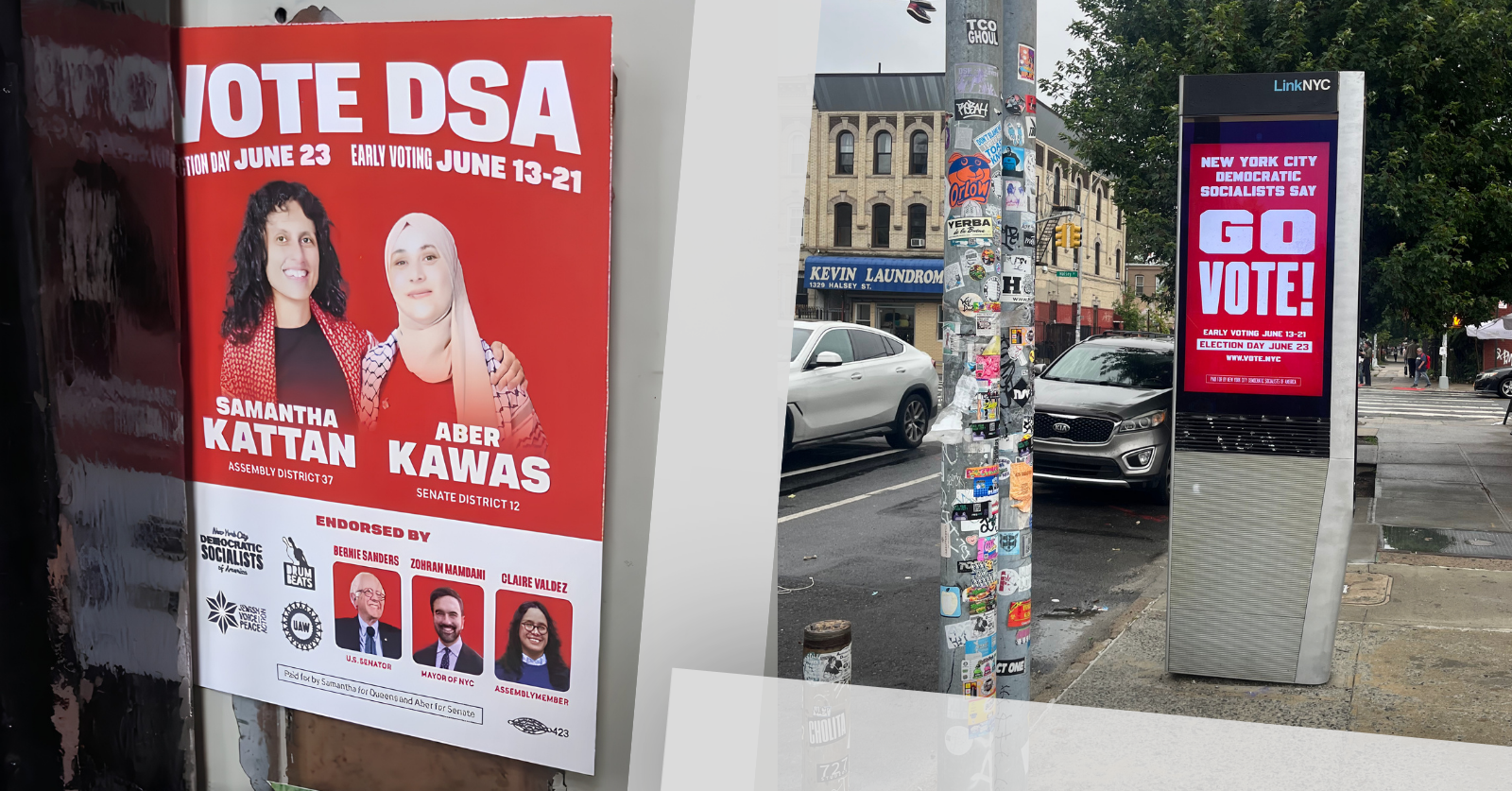
On June 23, when NYC-DSA gained two congressional seats and swept all but one of the elections for state legislature that it contested, something fundamental broke in city politics. Conventional political logic and more than a few conventional incumbents were thrown out the window, and a new form of politics emerged. For the first time in a century socialists not only won significant electoral power at all levels of government, they also created a new faction in politics.
Before 2025, the average voter in the Big Apple would have had a hard time telling the difference between a candidate of NYC-DSA and your run-of-the-mill progressive Democrat. DSA candidates were hesitant about emphasizing their identity as democratic socialists, often downplaying that identity in campaign literature, stump speeches, and canvassing scripts (social media was often an exception). Many of our socialists in office were also reluctant to be too confrontational toward Democratic establishment figures because they feared retaliation that would hinder their ability to be effective legislators.
Zohran Mamdani’s campaign in 2025, however, brought about a major change. Running for a very high-profile office, Mamdani’s socialist politics were front and center for all voters to see. When he won, it dispelled any remaining anxiety about being an out-and-proud socialist in city politics. In this cycle our candidates put the term “democratic socialist” on their literature, and the term was frequently used in the media and at the doors and on the streets to distinguish them from other candidates.
The distinction between socialists and progressives was especially significant this year because some of the highest-profile races presented voters with a choice between candidates representing the two philosophies.
In this election, having liberal progressive politics or appealing to identity politics was not enough to win. In Upper Manhattan and the Bronx, Darializa Avila Chevalier defeated incumbent Adriano Espaillat, who had called to abolish ICE despite voting to fund the agency in federal budgets. Nearly all of our state legislature candidates won by over 15 percentage points in neighborhoods across the city, often defeating progressive Democrats and entrenched incumbents. But the distinction between progressive and socialist politics was most evident in the race for New York’s 7th congressional district.
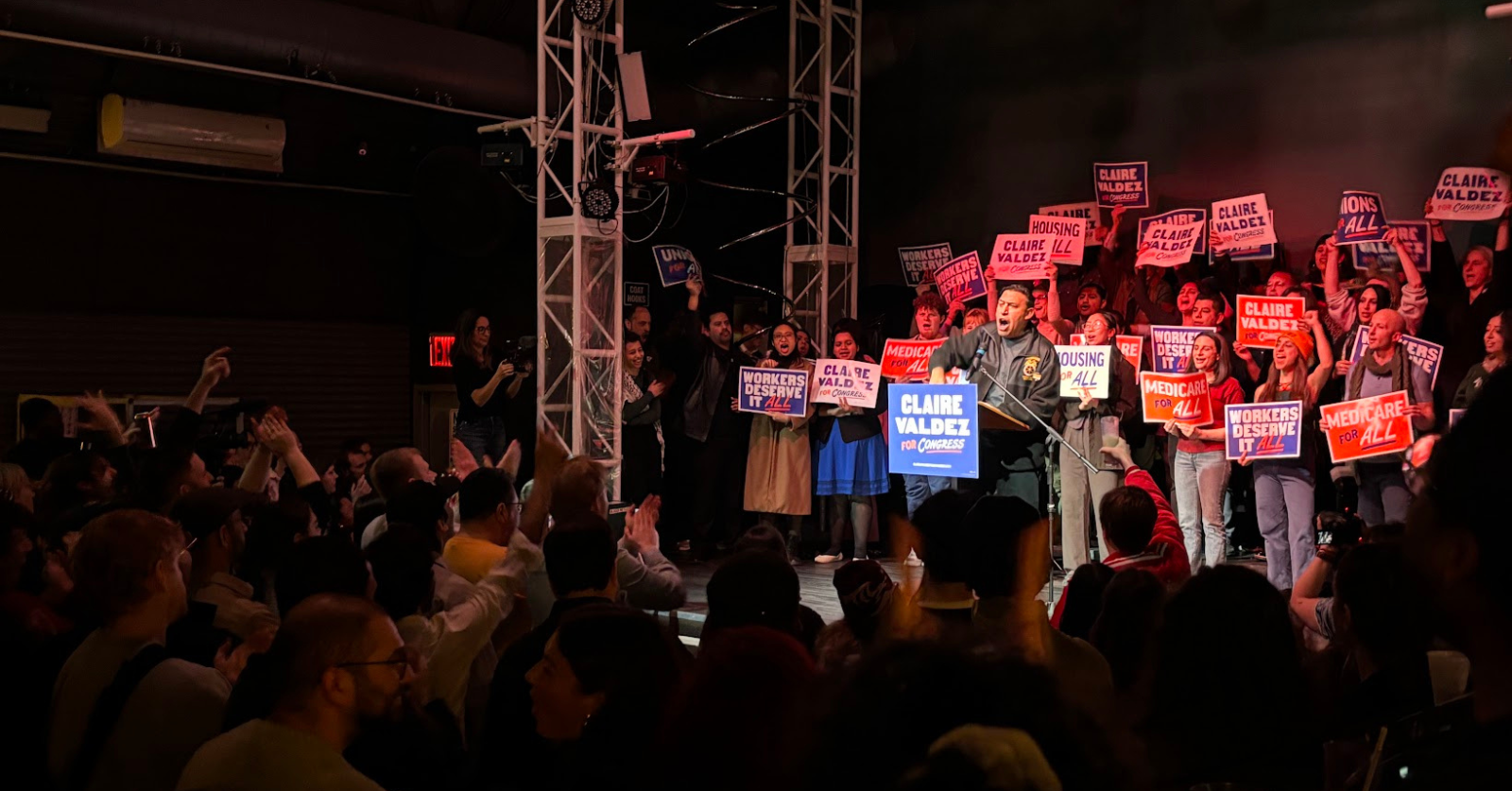
This contest featured DSA-endorsed Assemblymember Claire Valdez running against Working Families Party-endorsed Brooklyn Borough President Antonio Reynoso. This race is almost entirely within the “Commie Corridor” and is considered the most left-wing congressional district in the nation. Despite predictions that this would be a close race, Valdez won a commanding victory by beating Reynoso by more than 20 percentage points. Both Valdez and Reynoso support abolishing ICE, want to end the genocide in Gaza, and believe that housing should be a human right. But Valdez was also a leader in the democratic socialist movement. Before running for Congress, she was a rank-and-file union activist in the United Auto Workers, a member of the NYC-DSA Steering Committee, and a DSA-endorsed assemblymember. While canvassing, I proudly told every voter I could that Claire is a democratic socialist and backed by a movement made up of regular people like me.
Claire’s opponent’s endorsements came from a host of nonprofits and more conservative unions. For years, these groups have dominated progressive politics in the city, but they are fundamentally different from DSA. The key difference lies in how they’re organized: In many of these groups, the decisions to make endorsements are not made democratically. In NYC-DSA, every member can participate in the debate and vote on who we should endorse. But for many nonprofits these decisions are made by top staff, and many unions do not even include rank-and-file member input in endorsement processes. One of Reynoso’s top supporters was the Working Families Party, which has many unions and progressive organizations as affiliates. WFP members vote on endorsements, but the real power to make decisions lies with these organizational affiliates, whose vote weight is based on how much dues money they contribute. Another major contrast with DSA? These groups were unable to mobilize nearly as many volunteers as NYC-DSA. According to a call hosted by NYC-DSA, between all of our campaigns we knocked on 720,000 doors and had 10,000 canvassing shifts. In some neighborhoods on Election Day, you couldn’t walk a block without seeing a canvasser for a DSA-endorsed candidate.
The victory won on Tuesday by DSA was a victory for our whole movement, not just for the individual candidates involved or for Mayor Mamdani. In Valdez’s district and elsewhere, voters chose to support the politics of a membership-based, democratic, and socialist organization over the politics of progressive nonprofits and conservative unions. The reason is clear: In the face of so many horrific world events, abductions by ICE, the immoral wars and genocide, and the climate catastrophe, voters — working class and middle class alike — are looking for new ideas and answers. NYC-DSA proved that voters are tired of what mainstream Democrats and progressives have been selling; they’re ready to support democratic socialists, they will choose socialism.
In the wake of Tuesday’s victories, DSA needs to continue to be unafraid to be loud and proud socialists. This means running more socialist candidates, talking about socialism on the news and in the media, and being confrontational toward corporate Democrats. Our goal should be to have millions of working class people across not just New York City, but the entire country identify as democratic socialists.
As exciting as these victories are, however, there are still limits to how much our movement can grow as long as we’re trapped in the same political party with the liberal wing of the capitalist class and their politicians. To truly realize our power and expand political consciousness, we will need a real party of our own that can challenge Democrats in general elections. Furthermore, we must not lose sight of our ultimate goal: to build a new socialist society. In that vein, we need NYC-DSA to build a stronger relationship with the national organization. Socialism will not be achieved in one city or by winning any number of elections. It will be won when we can harness the power of the working class all over the country to fight for a socialist future. It was a missed opportunity that NYC-DSA’s congressional candidates did not seek a national endorsement from DSA. Had they done so, we could have brought more national DSA resources to bear to support them, and their presence on DSA’s nationally-endorsed slate would have helped strengthen the excitement about our other national DSA candidates.
The movement in New York City can and must be replicated everywhere. Electoral work in other cities — from Portland OR to Louisville KY and North New Jersey and beyond — is also making big strides and building a strong socialist political identity. As the title of a recent article published in The Call put it: the “hide the rose era is over.” The elections in New York City last Tuesday show that’s true in the Big Apple, too.