
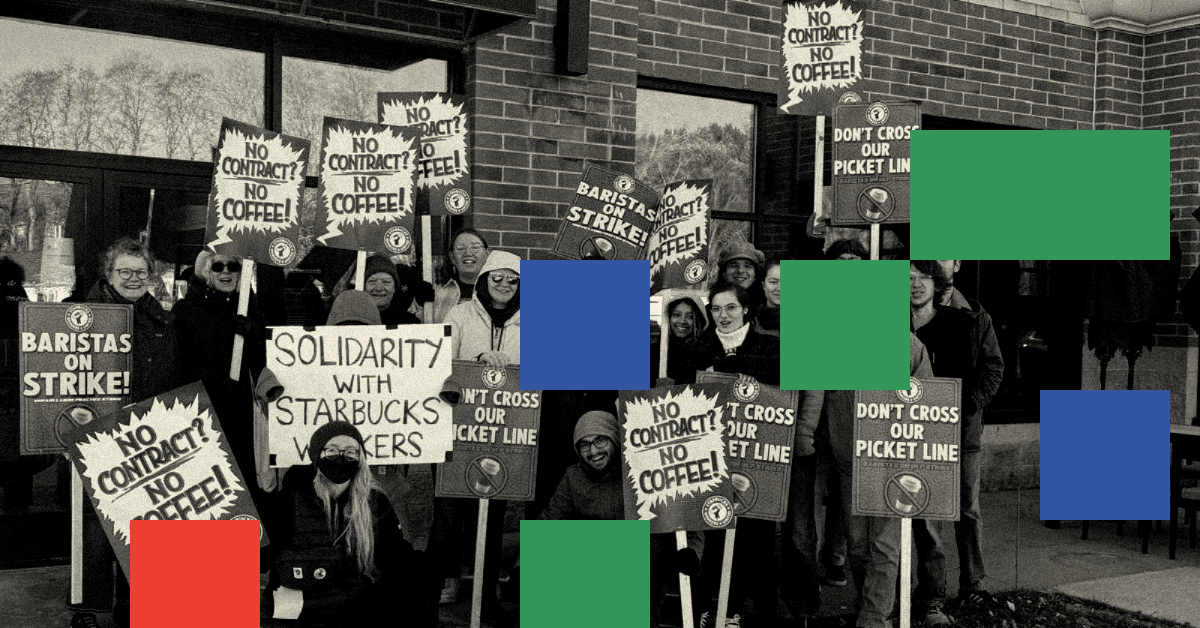
After five years of strikes, marches on the boss, petitions, and legal action, Starbucks Workers United (SBWU) called for a boycott in August. Beyond individual coffee drinkers, the union is asking universities, other unions, candidates, and political organizations to sign on to the boycott campaign.
Boycotts have a long history in the labor movement but can be risky. They rely on external support, and if they fail to make a dent in the company’s bottom line, they risk undercutting the momentum of the movement. Luckily for SBWU, unions are more popular than ever, and we’ve already seen that plenty of people are ready to throw down to support their baristas.
Since 2021, Starbucks workers have been organizing at an impressive rate. Anyone who pays any attention to the labor movement has heard about the rank-and-file energy that has led over 12,000 workers at almost 700 stores to organize unions. This is a movement built on bottom-up militancy. Through a pandemic, two presidencies, four CEOs, and intense company offensives, Starbucks workers have soldiered on.
Carried by the energy of the Bernie campaign, Black Lives Matter Movement, and Covid strike wave, the union has continued to grow rapidly. And at key inflection points, it has risen to the political moment, beginning with the labor-friendly Biden administration. Its National Labor Relations Board fast-tracked elections and frequently issued fines and injunctions against the company, helped, but it was reverberations of these consciousness-raising mass movements that actually inspired the workers. According to Eric Blanc’s We Are The Union, in 2022, more than 25% of leaders of new union drives cited BLM, Bernie Sanders, LGBTQ rights, or climate as the primary inspiration for their work.
And in October 2023, soon after Israel launched its genocidal campaign in Gaza, SBWU became one of the first unions in the US to call for a ceasefire. Immediately, the company filed a lawsuit, alleging that SBWU was harming its image. The result was an organic consumer boycott so widespread that, in conjunction with a 2024 holiday-season strike at more than 300 stores and several student-led pressure campaigns that cut university contracts with Starbucks, it brought the company to the bargaining table for the first time.
Initially, workers secured 33 tentative agreements on a number of issues, but with Trump and his counter-revolution coming to power, the writing was on the wall. The company would walk away in 2025.
The 2025 Strike
In 2025, while new stores were still organizing, the company was unyielding. That summer, SBWU set about building a strike big enough to make a real dent. Workers started organizing both internally and externally. While stores elected strike captains, the union worked to build a strong network of supporters who could bolster picket lines and take solidarity actions. Reaching out to both individuals and groups, SBWU and DSA came to work closely.
DSA, through its National Labor Commission (NLC), already had a strong system of Solidarity Captains. These members were point people in their chapters, with the know-how and the support to activate their comrades in support of workers’ struggles. We on the NLC worked to connect DSA solidarity captains to their local SBWU strike captains and built our own muscles in anticipation of a strike.
SBWU often chooses to launch national strikes on Red Cup Day, when Starbucks unveils its limited-edition holiday-themed cup. Every November, it proves to be the company’s highest sales day of the year. Having a concrete timeline was unusual and helpful for DSA. We were able to prepare captains ahead of time with all the information they needed, as well as a variety of support tactics chapters could use.
Using DSA’s Labor Solidarity Fund, the Labor Commission ensured that chapters had banners, megaphones, tents, and anything else they might need to support the picket lines. We even worked with a socialist chef to create a strike kitchen menu, enabling over a dozen DSA and YDSA chapters to bring good, hot food to the lines. In Pennsylvania and Nevada, DSA and YDSA chapters mobilized to support mass picketing outside Starbucks’ regional distribution facilities, disrupting shipments of beans and other key supplies across the Northeast and Southwest.
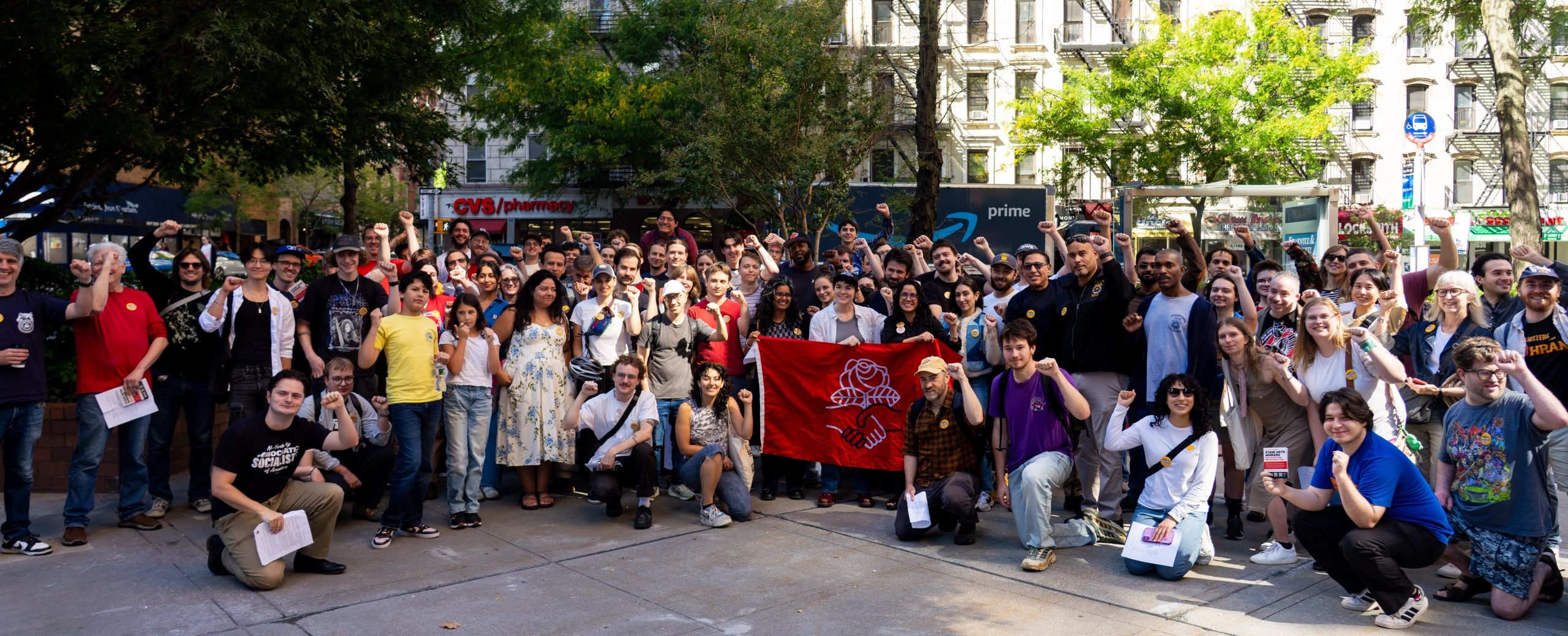
For the six-week duration of the strike, over 100 DSA chapters were mobilized. Whether supporting picket lines or talking to baristas and customers at nonunion stores, our nationwide strength was on display.
While the company claimed there was no effect on its bottom line, the union’s estimates suggested differently. New stores were inspired to organize. The movement grew. But the company did not fold. A few months later, SBWU returned to the bargaining table after submitting a new, lower wage proposal. Since then, the two sides have been bargaining off and on.
The Boycott Now
Since August 25th, for the first time, workers themselves are calling on customers to avoid all corporately owned Starbucks locations and products. This means stand-alone brick and mortar stores (excluding those in Target stores, airports, etc.), as well as Starbucks products in grocery stores.
Though it’s not yet clear exactly how the boycott will fit in a larger strategy to win a contract, it does build on SBWU’s strengths. To get the word out, Starbucks workers have continued to skillfully use social media, which was critical in the movement’s initial growth.
The boycott also functions as an effective structure test for the union: it can test its relationships with other organizations and with elected officials. The first stage of the boycott campaign included reaching out to unions and progressive organizations, including DSA, to pass resolutions in support and ban Starbucks products from their events, encouraging others to join. City councils in Atlanta, St. Louis, and Philadelphia have passed boycott resolutions, and Austin DSA members are now using their positions on the city council to fight for their own. Politicians like NYC DSA’s Claire Valdez have spoken publicly supporting the boycott and for the council to change procurement rules to prevent the city from buying Starbucks products.
Undoubtedly, building the boycott will require some action in the real world. While the union isn’t taking many of these steps yet, DSAers should be prepared to organize informational events and rallies alongside baristas in order to spread the word. In some places, we already have a good model.
Louisville DSA organized a solidarity rally with SBWU members in early September. According to organizer Galen Z.S., nearly 40 union siblings and DSA members came out in 100+ degree heat to occupy a strip of grass outside a Starbucks. Since that store was having its election a week later, the rally was an opportunity to demonstrate solidarity in the face of intense union-busting. (Though in the end, intimidation and threats led to an 8-7 loss.)
Rallies like this one are an example of the multifaceted strategy necessary to take down Starbucks. Worker action on the shop floor can occur alongside local advocacy groups, faith communities, and allies in other unions. When CEO Brian Niccol sees an unbroken wall of social opposition to drinking Starbucks coffee and 12,000+ union baristas acting in concert on the shop floor, the power built will be formidable.
What Will It Take?
Starbucks is a massive company. While SBWU represents more than 700 stores, there are over 10,000 corporately owned Starbucks locations in the United States. There are many thousands more workers to organize and elections to win, but a contract could be won before then. Whether it’s necessary to settle for a less lucrative first contract to temper company opposition or win a stronger contract to show workers that their organizing was worth it is still an open question.
Either outcome depends on the ability to keep applying pressure through frequent shop floor actions, effective strikes, and a mass boycott movement. All this must contend with high turnover: at many unionized stores, it’s not uncommon to see an entirely new set of workers just a year after an election.
Socialists have much to learn from this organizing drive, and an important role to play if it is going to succeed. While Starbucks may not be the “commanding heights of industry,” SBWU is a real breakthrough in organizing the service sector, a large and growing portion of the U.S. economy.
And Starbucks organizing drives have had a “spillover effect,” inspiring workers in other nearby workplaces to organize themselves. According to a study from Colorado State, nearly 20% of the nationwide increase in union elections since 2021 can be attributed to Starbucks organizing drive “spillovers,” with counties that saw Starbucks elections showing a 175% increase in union elections. And while union baristas don’t always stick around for long, they will take their class struggle experience with them for the rest of their lives.