
There are elections where nothing happens — this is usually the case — but every once in a while there are elections where big things happen. The back-to-back primaries in New York on June 23 and in Colorado on June 30 were both the latter kind of event.
The Scoreboard
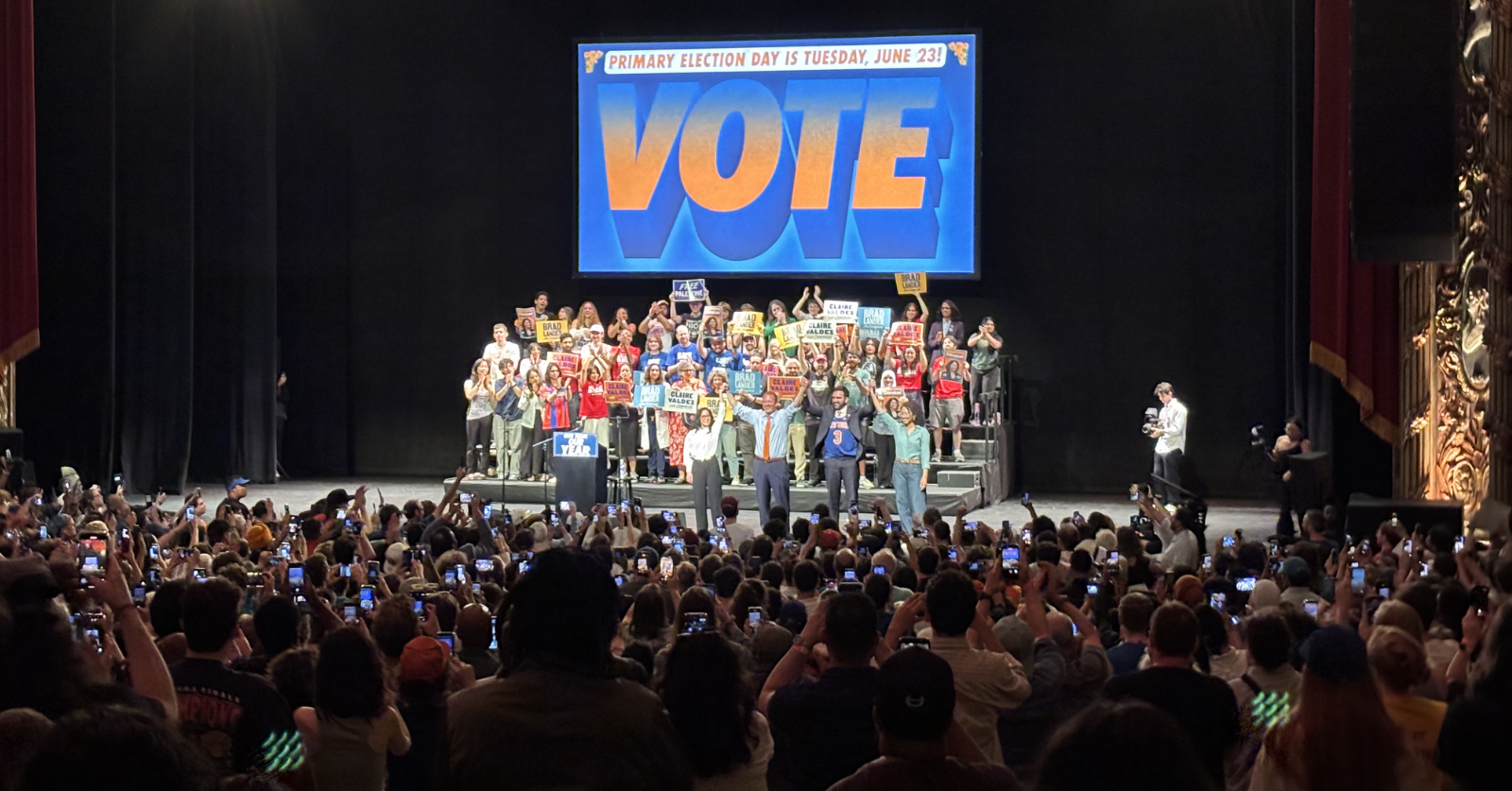
The slate backed by the New York City chapter of Democratic Socialists of America triumphed across the board in the state’s Democratic primary on June 23. Both of the chapter’s endorsed congressional candidates won decisive victories. Union organizer and state assemblymember Claire Valdez won her election to represent the “most left-wing district in the country,” which straddles the border of Brooklyn and Queens. She defeated progressive Democrat Antonio Reynoso, a Brooklyn politician, 56 to 36 percent. Palestine solidarity movement activist Darializa Avila Chevalier won a shocking upset victory (49 to 46 percent) against another “progressive Democrat” and long-standing leader of one of the city’s Democratic machines, Adriano Espaillat. DSA’s congressional foothold was further strengthened on the last day of June with the victory of Melat Kiros in Denver, Colorado, who defeated a long-term Democratic incumbent by almost 10 percentage points.
DSA also won big in the New York state legislature. NYC-DSA candidates Aber Kawas, Christian Celeste Tate, David Orkin, Eon Huntley, Illapa Sairitupac, and Samantha Kattan all won, in almost all cases with close to 60 percent or more of the vote (Sairitupac’s was closer, but the vote was also split six ways). Conrad Blackburn was the chapter’s only loss, though Blackburn came close to winning. Outside of NYC, Adam Bojak, a member of Buffalo DSA, also won his election to the State Assembly. They will join a bench of existing socialist legislators — three senators, five returning assemblymembers — all of whom won reelection. Assuming there are no surprises before the General Election, this means that DSA will now hold 4 of 63 seats in the State Senate and 10 of 150 seats in the State Assembly.
The recent slew of victories at the federal and state level are just the latest wins in a banner year for DSA’s electoral project. DSA-endorsed candidates have made breakthroughs in state and city elections across the country — including in Louisville, Kentucky, where Bread & Roses member Robert LeVertis Bell won his race for state assembly.
Big Impact
The victories in NYC by Valdez and Avila Chevalier were international news, making headlines from Germany to Brazil, Colombia, the UK, Spain, Pakistan, Singapore, and more. They are a major morale boost for DSA, and the organization is growing rapidly in their wake: nationally DSA added 4,000 members in the first 72 hours after the election, and the NYC chapter now has more than 15,000 members — over 800 of them who joined in the week after Tuesday’s election. No doubt Kiros’s win will only add to this momentum.
The victories and the response to them are also proof that the organization has truly “come of age,” almost exactly ten years after its rebirth in November 2016. The Left in the United States, with DSA at its center, is now a national force that can’t be ignored or treated as a marginal player. At the federal level, Valdez, Avila Chevalier, Kiros, and Chris Rabb, who won his Philadelphia primary in May, will join fellow DSA members Alexandria Ocasio-Cortez and Rashida Tlaib to bring DSA’s foothold in Congress to 6 members. DSA could add a further seat depending on what happens in the election contested by Oliver Larkin in Florida on August 18 (though Larkin will then have to go on to win a competitive general election). At 6 members, DSA’s hold in the House surpasses the high point in the 20th Century for an organized left-wing presence that was achieved by the Farmer-Labor Party in the mid-1930s.
More important than numbers is the program on which the DSA candidates were elected. All won, not in spite of, but because they supported a clear platform: Medicare for All, strong unions, taxing the rich, abolishing ICE, an end to Trump’s War on Iran, and an arms embargo on Israel.
How It Was Won in NYC
Three factors were decisive in DSA’s victory in the Big Apple (others will have more to say about the results in Colorado and upstate New York).
First, the mounting sense of disgust among the Democrats’ base with the party’s leadership has reached a new high. The party is currently led by Senator Chuck Schumer and House minority leader Hakeem Jeffries, both of Brooklyn. Their timidity in the face of Trump’s relentless assault on civil liberties and his wars abroad, coupled with their support for Israel’s genocidal campaign in Gaza and Lebanon and their inability to offer a positive program has lost them the support of their base. The vast majority of establishment Democratic politicians who follow them have fallen into disrepute with Democratic voters, too, for much the same reason. DSA has been able to make the argument to growing numbers of activists and voters that a much bolder course is needed. Critically, the base for a new kind of politics — while still limited for the most part to the big cities — has included both middle-class and working-class voters of all racial backgrounds.
Second, Zohran Mamdani has successfully used his role as Mayor of New York City to prove that an alternative political program and strategy is not only desirable, it also can work in practice. In the first six months of his administration, Mamdani fulfilled two of his three major campaign promises: he expanded the city’s childcare program and froze the rent for almost half the city’s renters. He has also not been shy about promoting these victories, and he has used his bully pulpit to take on the city’s landlord class and its most exploitative employers. As a result, Mamdani’s endorsement of Valdez and Avila Chevalier was a major boost for their campaigns. Mamdani gambled big, going all out to support both candidates and putting his reputation on the line. That wager paid off.
Finally, NYC-DSA’s own contribution — combined with the support of the United Auto Workers and a host of smaller reformed unions and community groups — deserves major credit. The army of volunteers from DSA overwhelmed the opposition all over the city. As Alex Pellitteri described in The Call earlier this week, if you walked through some neighborhoods on election day, you would have seen a DSA activist on almost every major intersection. NYC-DSA also built a strong socialist identity for our candidates that proved to be a boon to our ability to link all these different races together.
Blowback from Democratic Leadership
Victory for the Left also meant defeat for the Democratic Party leadership. This time, they did not take it in stride. Outraged Democratic leaders denounced the rise of DSA. Many of course also fear for their own careers: Schumer and Jeffries, to start with, could face serious primary challenges in two years. Other leaders representing big cities will — if all goes well — face similar challenges.
The days are gone when Democratic leaders could ignore DSA’s growing strength. What this will mean for the future is unclear. But it seems reasonable to think that Democratic leaders will no longer take a “strategic silence” approach to a growing democratic socialist movement.
Some Democratic leaders — current (see Neera Tanden, president of the party’s leading think tank, the Center for American Progress) and former (see Jamie Harrison, past chair of the Democratic National Committee) — have begun to suggest that DSA has a “parasitical” relationship with the Democrats. DSA is fiercely critical of the party, and rightly so, but makes use of the opportunity Democratic primaries provide to win elections.
There’s a sense in which the “parasitical” accusation is correct, though the solution would be for Democratic leaders to back reforms like proportional representation for House elections and ranked choice voting for presidential and Senate elections. Socialists should welcome reforms to electoral rules that would allow us to get a “divorce” from centrist Democrats and their business class backers. That’s why Rashida Tlaib is right to support the Fair Representation Act, which would transform US elections. Hopefully DSA’s new congressmembers will follow suit. But so long as Democratic politicians support an electoral system that 1) makes forming an independent party difficult and 2) leaves the path open for socialists to make major electoral advances in primary elections, there’s no reason for DSA to abandon that tactic. Running independents and experimenting with fusion ballot lines also make sense as electoral tactics depending on which of the six different party systems in the US that DSA is working with, but — given the hand dealt us — it would be a mistake to abandon work inside Democratic primaries.
A New Period in DSA’s History
The elections weren’t just a defeat for the leaders of the Democratic Party. They were also a blow to the progressive Democratic wing that occupies the middle space between party leaders on the one hand and the democratic socialist left on the other. Valdez, Avila Chevalier, and Kiros all ran against progressive Democrats who had the support of many of that wing of the party’s leaders and organizations. In Valdez’s district, the progressive Working Families Party helped lead the Reynoso campaign. Their stunning defeat revealed how small their social base actually is in the city. The leading group on the Left, for now and at least in New York City, is DSA.
These breakthrough victories took place as many speculate that Representative Alexandria Ocasio-Cortez will launch a presidential campaign next year. But compared to all the positive developments so far this year, AOC’s role in the primary elections has been a major disappointment. Despite being arguably DSA’s highest-profile member, AOC maintained strict neutrality in all the congressional races DSA contested. By contrast, Mamdani and Bernie Sanders both endorsed different combinations of the socialists. AOC herself endorsed two other candidates for Congress this year who were to the right of DSA’s candidates and came to Hakeem Jeffries’ defense days after the New York election, just as more people began to question whether or not he should be the Democrats’ leader in the House.
AOC has repeatedly demonstrated a tactical conservatism and an unwillingness to rock the Democratic boat, qualities that are a major liability in a party still dominated by its pro-business wing. It was this tactical conservatism and desire to “unify” the party that also led her to defend Joe Biden and Kamala Harris’s inexcusable support for the genocide in Gaza. AOC will decide whether or not to run for president independently of DSA. If she does run, DSA will have to decide whether or not to support her. But her overly-cautious approach to internal party politics raises serious doubts about her ability to lead an insurgent movement in the presidential election, not to mention her ability to lead the party and the federal government were she to win.
DSA’s more contentious relationship now with the progressive wing of the Democratic Party and the emerging challenge of how to handle the presidential campaign are just a taste of the challenges that await DSA in this new period. Since its rebirth in 2016, DSA has slowly built up a presence in the labor movement, in social movement campaigns, and in state and local governments. But it has remained relatively distant from national politics because its weight in Congress has been so minimal. As important as Tlaib and AOC have been to the Left, they have also maintained a greater independence from DSA, in large part because they could credibly claim to have an independent power base.
But DSA’s involvement in national political fights will have to increase significantly now as candidates enter Congress who are much more “of” the organization. Valdez especially is a serious, long-term DSA activist who was previously an elected member of NYC-DSA’s chapter leadership. To adapt to this new situation, DSA’s members and caucuses will have to demonstrate a new level of maturity. We will also have to take national debates much more seriously. The National Political Committee will have to debate and take positions on emerging political questions on a much more regular basis, and we will need a stronger communication operation to promote our ideas and build off our recent breakthroughs to strengthen our organization.
All this is doubly important because DSA also has a new level of responsibility in the fight against Donald Trump and MAGA. Mamdani’s win in 2025 and the new string of victories this year prove that there is a growing base of both working- and middle-class voters who are ready to support democratic socialist politics. DSA can’t just be critics on the sidelines, we have to take seriously our role as a national force. For example, DSA’s position on the 2028 presidential elections will matter much more than it ever has before. That means that it will no longer be possible for the organization to abstain from choosing a side in the General Election, unless it really views both the Democratic and Republican candidate as “two sides of the same coin” — something that is hard to imagine will be the case.
This, in short, is the stuff that turns a routine election cycle into something else entirely. A new period for democratic socialists in the US has arrived.