
The November 11 Spanish general strike was the product of social movement protests around the cost of living that have been bubbling for at least two years. Housing rights struggles have sprung up around the country, as rising real estate values combined with low salaries have made rents nearly unaffordable for much of the working class.
Housing unions began discussing calls for a general strike at least a year ago. It was the September 23 eviction of Maricarmen Abascal at age 87 that sparked outrage throughout the country. Her death less than two weeks later galvanized calls for the general strike. Most of the union federations got on board after the movement agreed to demand both lower rents and higher salaries.
In Catalunya organizing for the strike was led by the “Ens Costa La Vida” (it costs us our lives) coalition, based on an alliance between housing rights organizations and the smaller union federations. For weeks in advance coalition committees flyered and postered and did outreach in workplaces and schools.
Estimates are that 4 million people participated in the general strike. The extent to which workers shut down their workplaces varied from region to region.
The movement continues today with protests for housing rights and for freedom for those arrested during the general strike. In an effort to synchronize with the French protests which now take place every Saturday, the teachers unions in Catalunya organized a protest march for school funding and teacher salaries on November 21.
The hope now is that workers learned the lessons of how to organize co-workers, and that the housing activists will see how popular their demands are and will continue the struggle.
October 12: A Month to Prepare
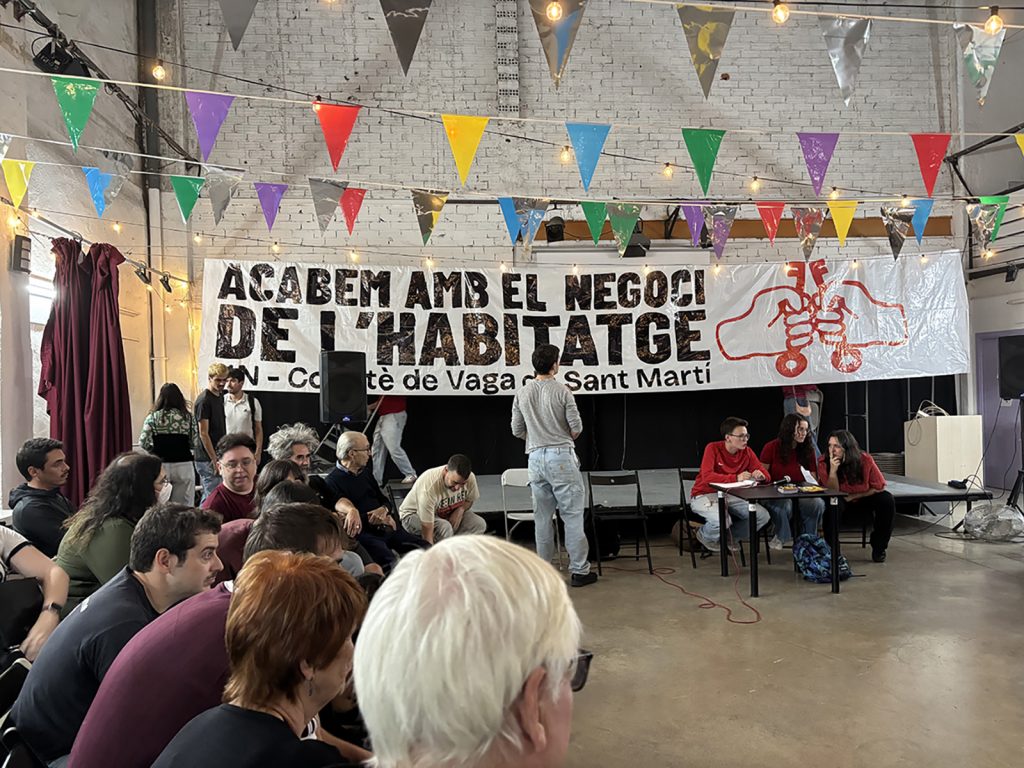
I attended my neighborhood meeting for planning the general strike in the Spanish state on November 11. I live in Barcelona and went to the meeting for the Sant Martí barri (neighborhood). The planning meeting was attended by a little over 100 people.
Sant Martí is a long group of smaller neighborhoods that runs east-west, north of the center of the city. It includes Poblenou, once an industrial center and now a rapidly gentrifying and increasingly expensive area with a boulevard that runs right up to the sea. Further west (away from the sea and toward the mountains) are groups of very working-class and sometimes impoverished areas. West of that, where I live, is El Clot, a working- and middle-class area that is very Catalan, a bit less expensive than Poblenou.
The meeting was conducted in Catalan, as are nearly all left or movement meetings here. The actions in Catalunya are being organized by the “Ens Costa La Vida” coalition, an alliance of housing rights unions and minority labor unions (such as the General Confederation of Labour, or CGT).
The meeting lasted about 90 minutes and the attendees were mostly young. The four chairs were young people (under 35), three of whom were women. After briefly presenting the reasons for the strike planned for November 11, they opened the meeting up to discussion.
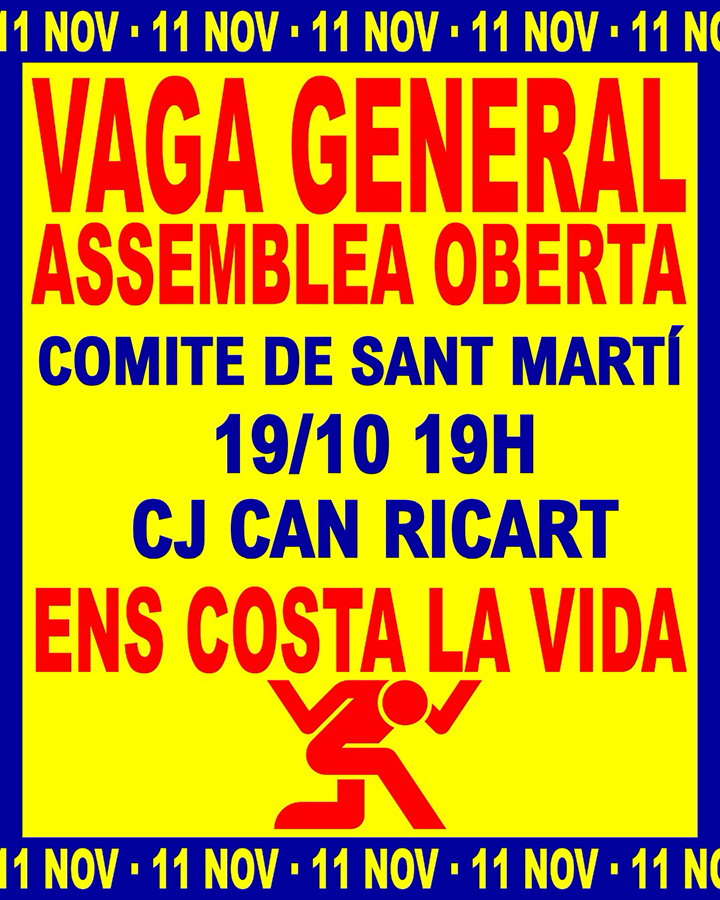
The general strike has the backing of several union federations who are part of the larger coalition involved in planning, but it was mostly the tenants’ unions that organized this neighborhood meeting. An Anticapitalistes comrade made some practical suggestions about getting the word out, and then we broke up into four committees: workplace outreach, education institutions, social movement alliances, and agitation/propaganda. I joined the last one. Mostly, we just quickly reviewed how we can get flyers out and where we can carry banners.
We meet again as a subcommittee next Monday; a WhatsApp group was set up for the 30 or so of us on the committee. There are at least four or five other neighborhood meetings like this taking place around the city. Now neighborhood groups use a template to advertise strike preparation meetings.
November 11: The Strike
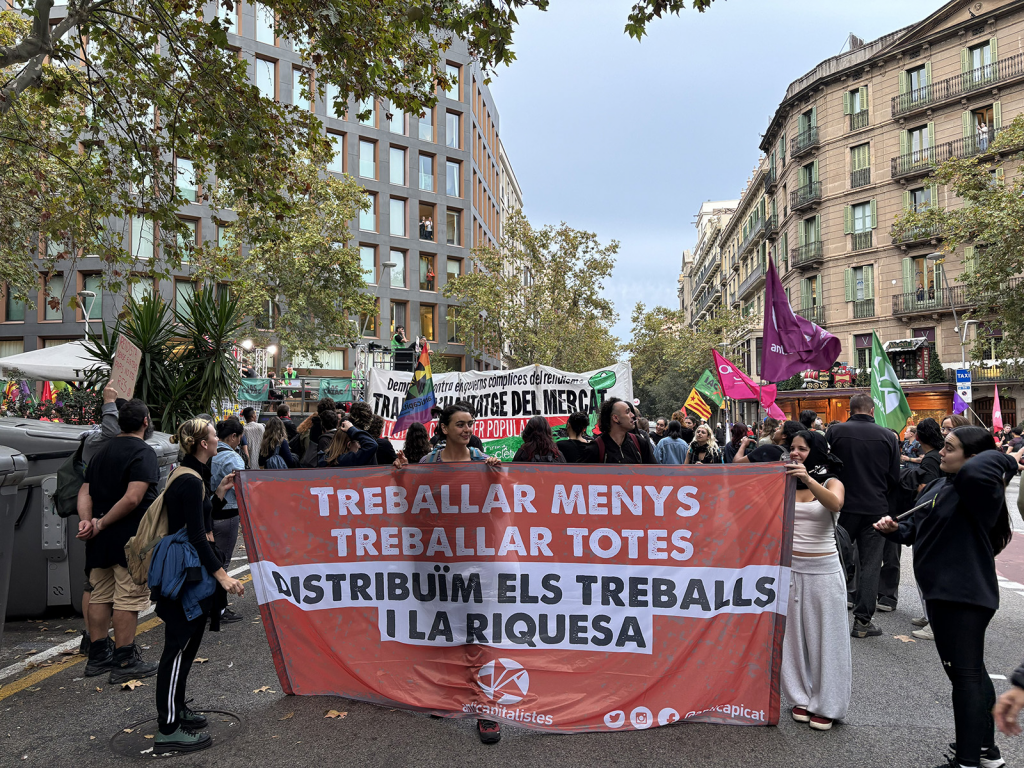
10:00 AM. I arrive at the Glòries shopping mall. This is part of the international Westfield chain which has several malls in the United States as well. We block off the entrance to the mall. A CGT contingent had gone inside to make sure everything was shut. Another CGT contingent marches to another location. Many youth from the housing rights unions were standing in front of the entrance. When the organizers realize we have more than enough to block the gates, they ask us to spread down the block to block off McDonald’s. That results in that store closing down as well.
Messages keep circulating on our WhatsApp list. Urgent requests for people to come help block other neighborhood locations. Small groups respond. A message on the Anticapitalistes Telegram channel says that the construction work on the Rambla (the main tourist attraction) has been shut. I see in front of me the major street construction sites along Avinguda Diagonal are also empty. These are both massive and long-lasting infrastructure projects.
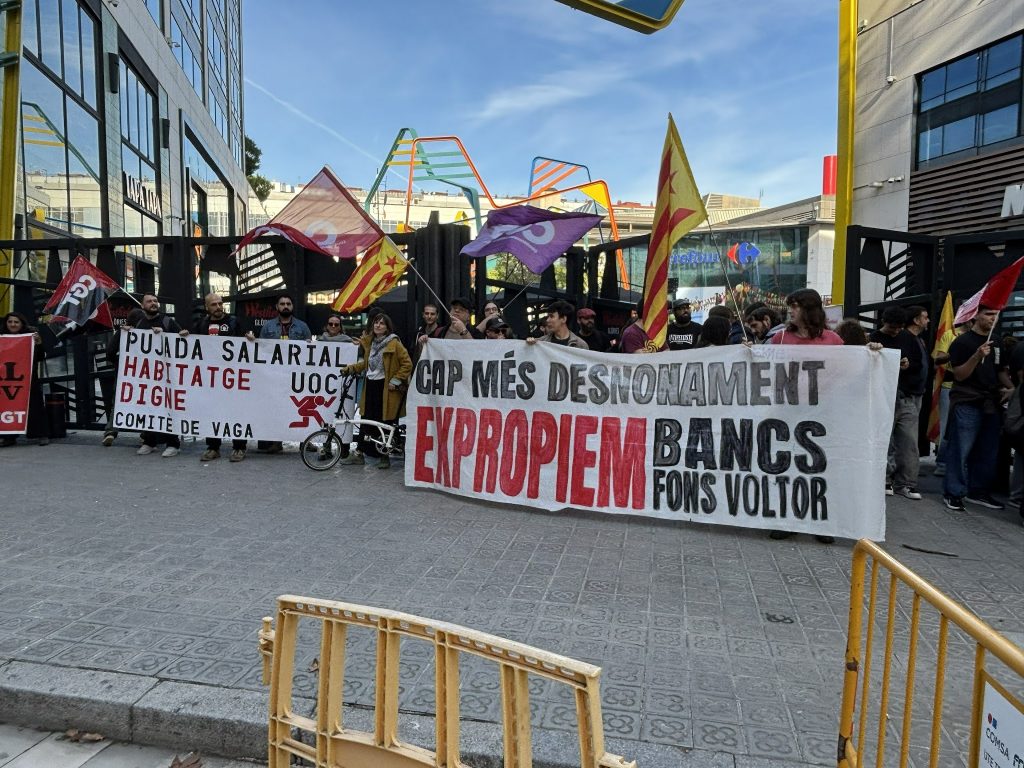
10:15 AM. Suddenly the crowd outside the Glòries gate is swelled by district strike committee members emerging from inside the mall reporting that everything is shut. We have far more people than we need and contingents begin to form to shut down other places.
10:30 AM. I follow a contingent of maybe 75 people toward the Poblenou neighborhood. They are chanting, “People without houses, houses without people, can’t understand.” (It rhymes and sounds better in Catalan).
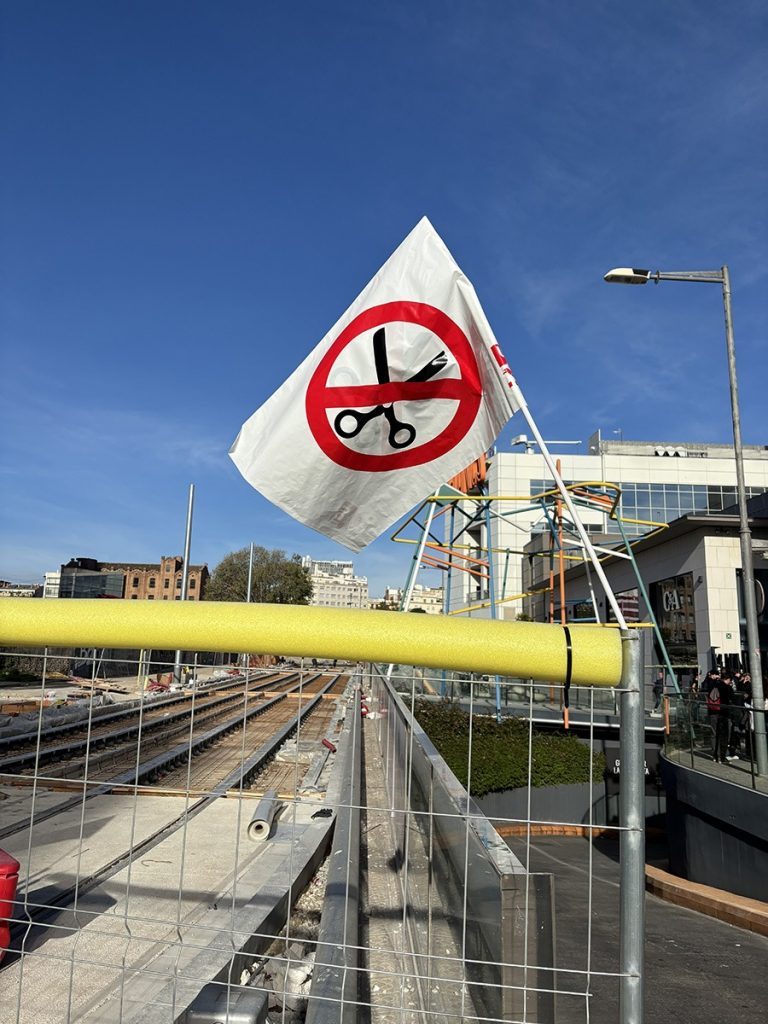
10:45 AM. The contingent now seems to have at least 100, with many CGT banners. Some messages circulate on our district WhatsApp group acknowledging the difficulty of coordinating so many contingents.
11:00 AM. On Rambla del Poblenou, a major tourist and commercial boulevard, we stop to block the Four Points Sheraton Hotel. Hotels and shopping malls are targeted because of their roles in bidding up real estate prices. A few dozen move into the lobby to chant strike slogans. “Long live the struggle of the working class!” Eventually we are kicked out. Actually, shutting this down was never plausible given all the guests inside.
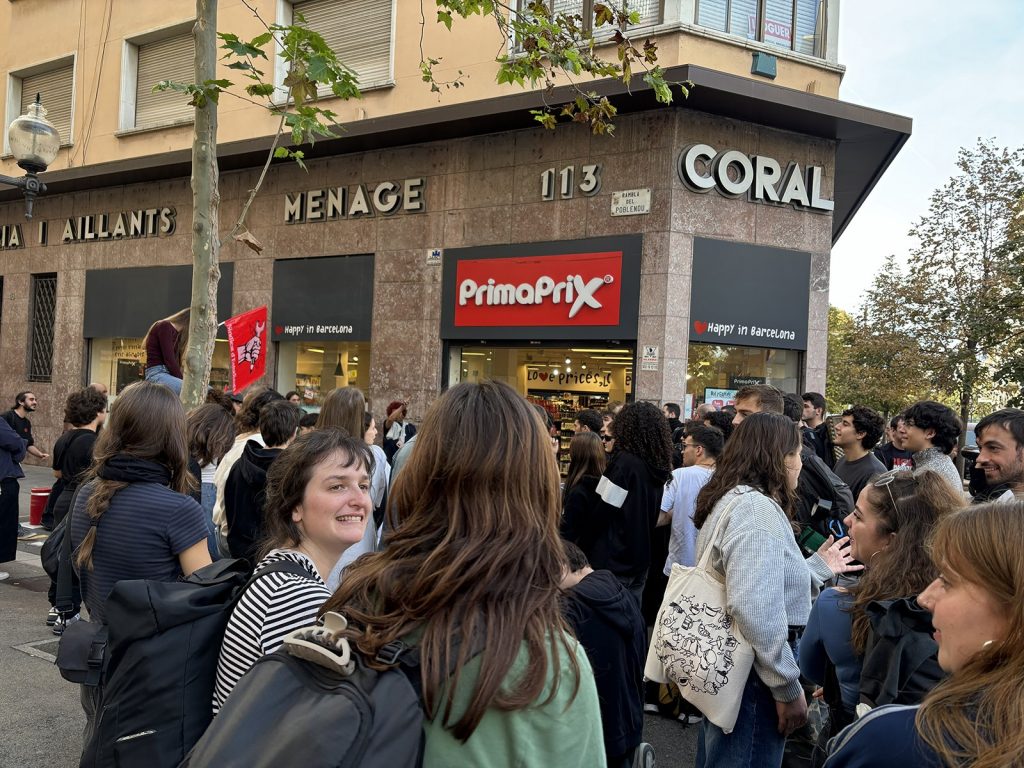
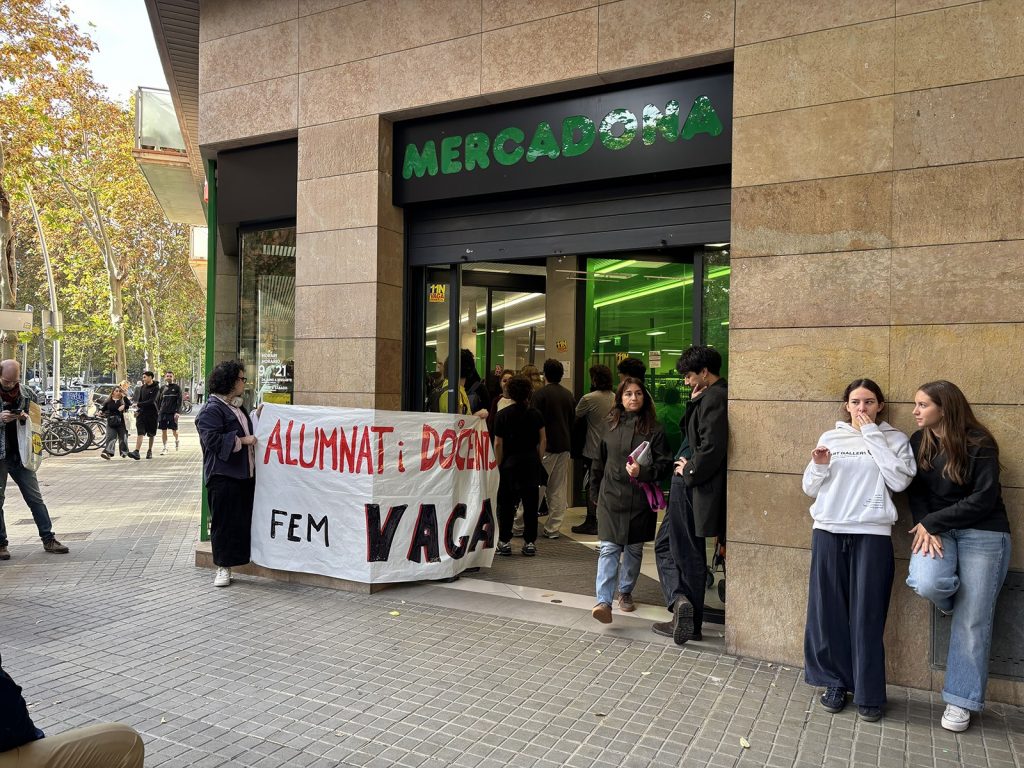
11:15 AM. We march further along the Rambla del Poblenou to temporarily block PrimaPrix, a chain store. Our people have filled the entrance of Mercadona, a major supermarket chain. Customers can exit but newer shoppers are turned away. The store sets off the fire alarm, which draws no response from the police parked a block away. Finally, management agrees to shut the metal curtain and the window shades. The protesters emerge cheering. An additional chant now, “A-Anti-Anticapitalistes!”
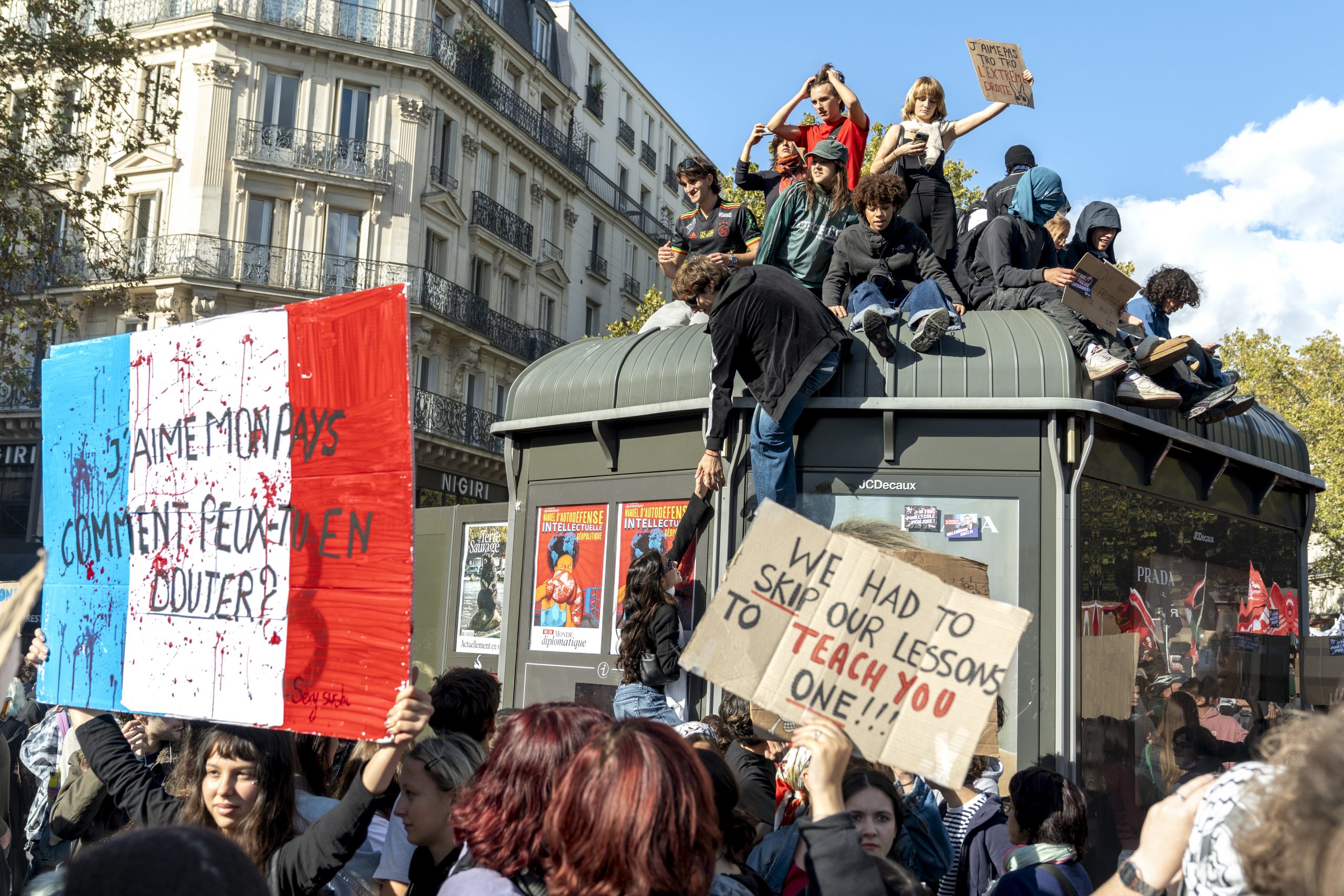
After marching around to find other targets to shut, we return to Mercadona and see it is still shut. At that point two groups of elementary school students, led by their teachers, march up Poblenou. They stop by us and we all exchange exuberant cheers. Teachers and students have played a major role in the buildup to this day. Every school in our neighborhood has been adorned with protest and general strike signs, complaining of underfunding, lack of housing for the students, and lack of support services.
Turning the corner we shut down another supermarket, Bonpreu.
A report was posted on the Anticapitalistes list that 50-65% of commerce had closed in Barcelona. My thoroughly subjective glance around the neighborhood is consistent with that. There are some bars and small restaurants open, especially those that belong to larger café chains. But at least half have their shutters down. For the establishments the protesters closed, the result was more disruption than full closure, as many seemed able to reopen later in the day. The intent was also to reach workers inside. There were few conflicts with employees in these stores. The one exception was at Bonpreu, where one protester appeared to have expropriated an apple.
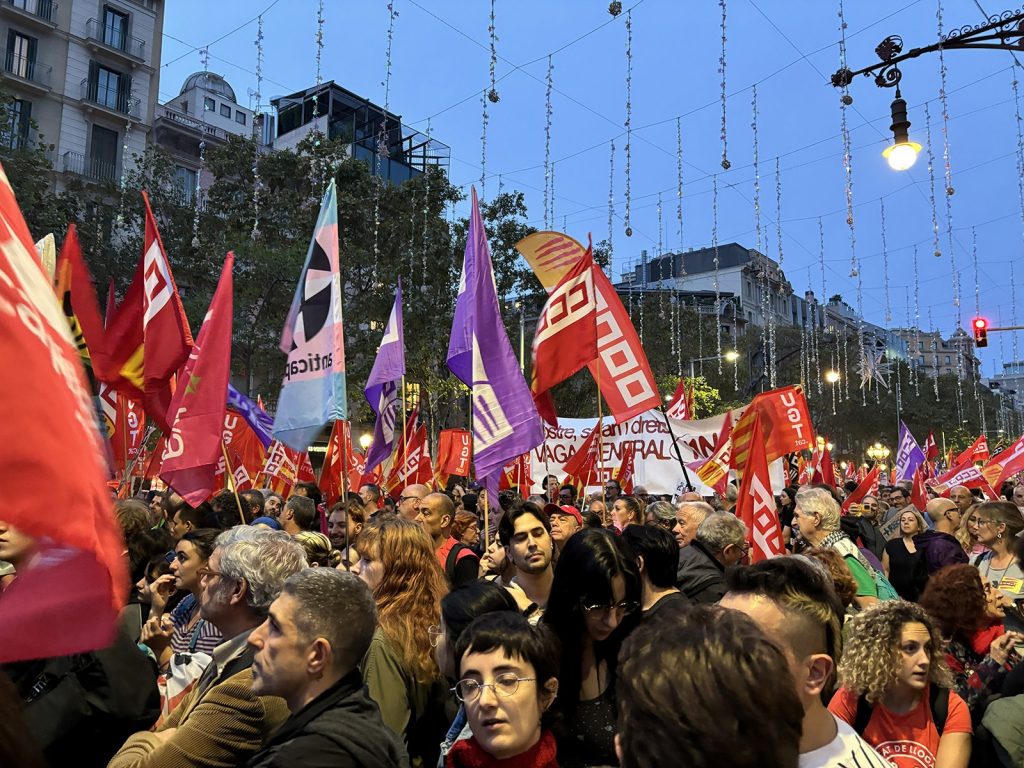
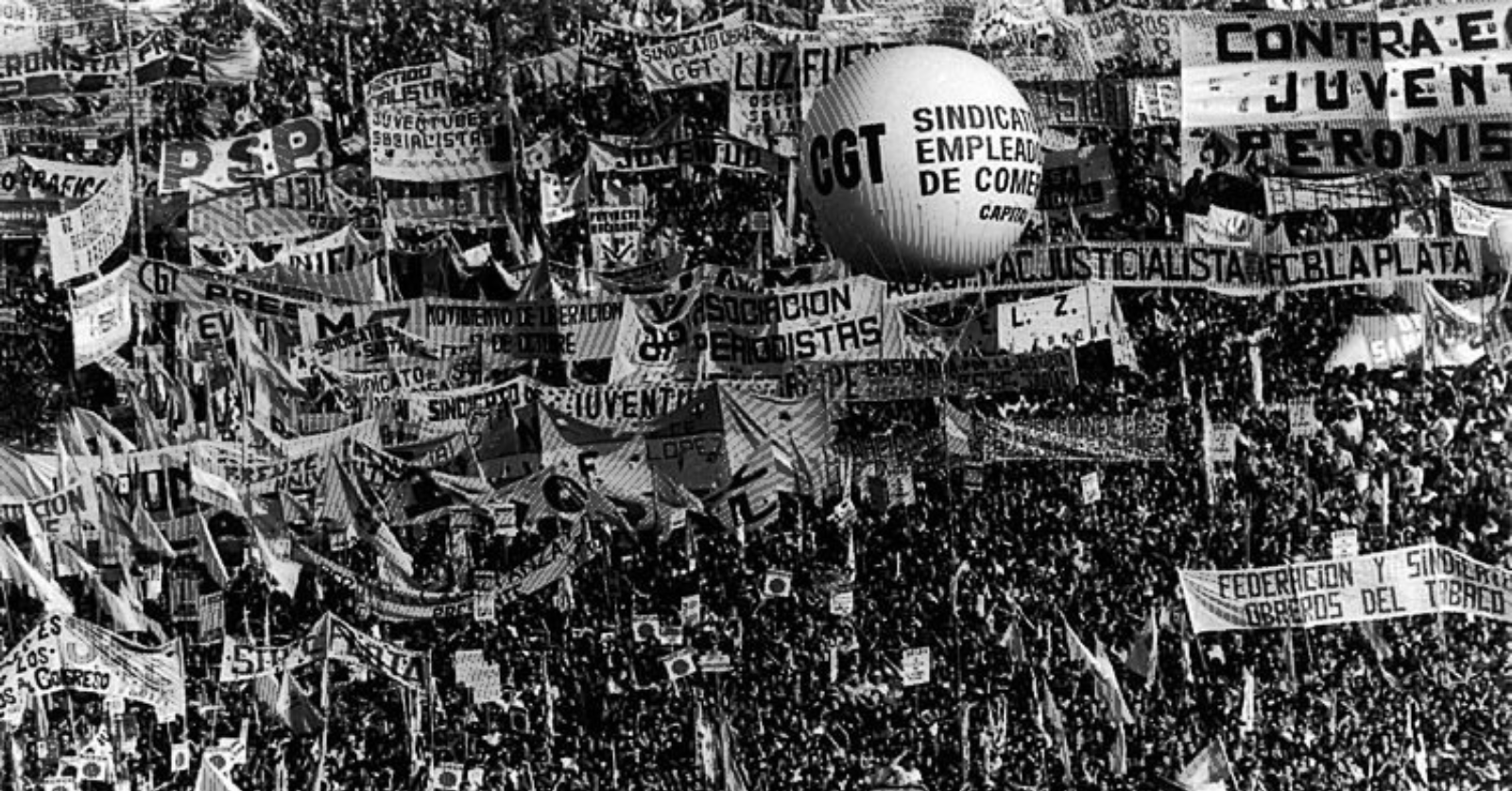
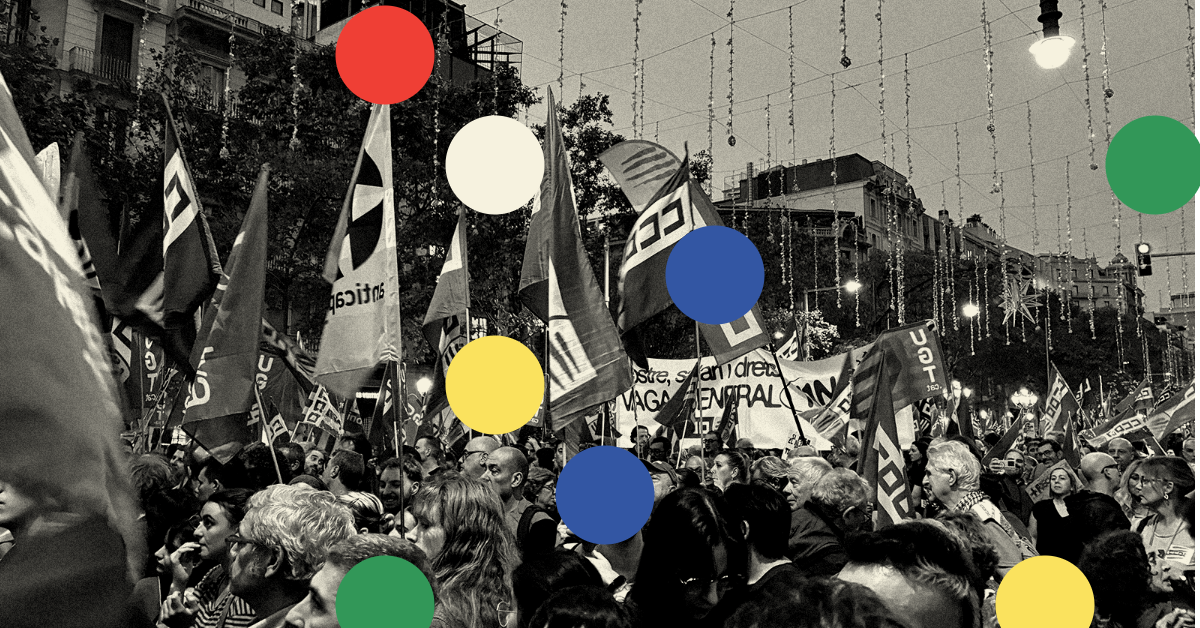
5:00 PM. The main march. Feeder groups converge on Passeig de Gràcia, a major commercial and tourist boulevard which reminds me of New York’s 5th Avenue, but in Catalan modernisme style. The photos and captions tell the story. The crowd has been estimated at 400,000. I’ve seen reports of mass rallies in the Basque Country, Valencia, and Madrid so far. In Madrid there were 500,000 in the streets, and that number might have been higher had it not rained so hard there. (Fortunately, the rains came to Barcelona only later in the evening.)
The crowd was so massive, packed, and slow-moving it was hard to see all the contingents there. But the energy levels were quite high. The Anticapitalistes led those around us in singing one of the songs from the French protests, translated into Catalan. A group of French students, who had come to support the general strike, joined in and then sang the original French version.
The rally was larger than many of the organizers seemed to expect, which is good given the deep crisis into which the Spanish state is about to enter. Most expect a center-right government to emerge from the snap elections called for on November 29. In my district committee, the very young leaders had said all along that the general strike was the best way to prepare for the fight against a right-wing government.
[This article adapts two pieces that first appeared in Against the Current: “A Month to Prepare for the General Strike” and “Notes on the General strike in Barcelona, 11 November 2026.”]